How to Measure Customer De-escalation Skills Before They Cost You a Customer?
Your agent scored 95% on the training assessment. Then lost a customer in four minutes.
The customer was angry about an incorrect charge. The agent knew the refund policy, followed the approved script and used the empathy phrases they’d learned during training.
By the end of the call, the customer was demanding a supervisor and threatening to cancel their contract.
It’s a hypothetical scenario, but a familiar one for anyone managing a customer service team.
The employee passed the test. Their actual performance told a different story.
Many organisations measure customer service training through completion rates, knowledge assessments and post-training surveys. These metrics are useful for understanding participation and learning, but they reveal little about how employees behave when a conversation becomes difficult.
If you want to know whether your team can handle angry customers, you need to measure what happens during the conversation.
And ideally, you should do that before a real customer becomes the test subject.
What are customer de-escalation skills, and how do you measure them?
Customer de-escalation skills are the communication behaviours employees use to reduce tension, understand a customer’s concern and move a difficult interaction towards an appropriate resolution.
They include active listening, emotional regulation, clear communication, conflict management and the ability to recognise when escalation is necessary.
These skills can be assessed through structured conversation simulations, observed role-play and quality assurance reviews of real customer interactions.
The important word here is observed.
Asking an employee to explain how they would calm an angry customer measures their knowledge. Watching them respond to someone who repeatedly interrupts, rejects their explanation and demands an immediate solution provides much more useful evidence of their ability.
Why your current customer service training metrics may be misleading
Consider three common measurements.
Training completion rate: Everyone attended the workshop.
Knowledge assessment: Most employees correctly identified the company’s complaint-handling procedure.
Post-training satisfaction: Participants rated the course highly.
All three results might be positive while customers continue experiencing poorly handled conversations.
The distinction between learning and workplace behaviour is well established in training evaluation. Donald Kirkpatrick’s four-level model separates reaction, learning, behaviour and results.
An employee enjoying a course doesn’t demonstrate that their behaviour has improved. Passing an assessment doesn’t automatically establish that they can apply the knowledge at work.
For customer service training, the most valuable question is whether employees consistently demonstrate the required behaviours during difficult interactions.
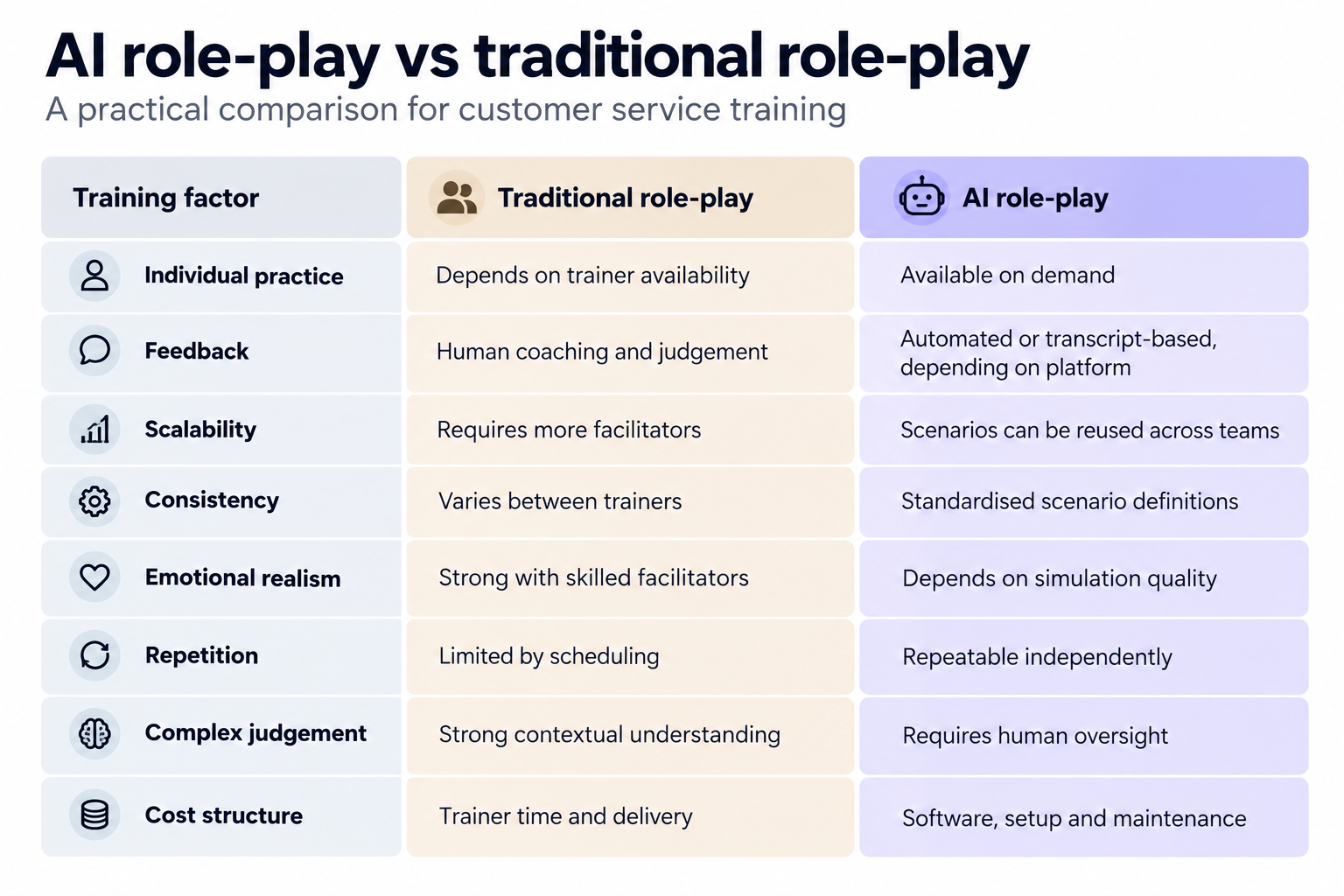
This is also why comparing AI role-play with traditional customer service training should involve more than the number of practice sessions delivered.
More training only matters when it improves performance.
Five behaviours every customer de-escalation assessment should measure
A useful customer service assessment needs clear criteria. Otherwise, performance reviews become subjective, and two evaluators may reach completely different conclusions about the same conversation.
Start with five observable behaviours.
1. Does the agent identify the actual problem?
An angry customer may begin a conversation by demanding compensation.
But compensation might not be their main concern.
Perhaps they’ve already contacted the company three times and nobody has explained why the problem keeps happening.
A skilled agent asks appropriate questions, checks the customer’s understanding and establishes what needs to be resolved before offering a solution.
What to assess: Did the employee identify the underlying issue, or did they respond only to the customer’s initial demand?
2. Can they acknowledge frustration without sounding scripted?
There’s a difference between recognising someone’s frustration and mechanically repeating an empathy statement.
Customers notice it.
An agent who says, “I understand your frustration,” for the fourth time without addressing the issue may actually increase tension.
What to assess: Did the employee acknowledge the customer’s specific concern and demonstrate that they understood it?
3. Can they remain composed when challenged?
This is where classroom knowledge frequently meets its limits.
The customer interrupts. Questions the agent’s competence. Accuses the company of dishonesty.
The employee needs to remain professional without becoming defensive, dismissive or unnecessarily apologetic.
What to assess: Did the agent maintain appropriate communication under pressure and adapt their response when the conversation became confrontational?
4. Can they explain a realistic next step?
A customer doesn’t always get the outcome they want.
Sometimes a refund isn’t possible. Sometimes an investigation takes several days. Sometimes the agent simply doesn’t have the authority to make a decision.
Good de-escalation includes explaining those limitations clearly while offering an appropriate next step.
What to assess: Did the employee communicate available options accurately, avoid unsupported promises and establish what would happen next?
5. Do they recognise when escalation is necessary?
Reducing escalation rates shouldn’t mean discouraging legitimate escalations.
An employee who attempts to handle a serious complaint beyond their authority can create a much bigger problem.
What to assess: Did the agent recognise when specialist intervention was required and follow the correct procedure?
These behaviours provide a practical starting point for a customer service quality assurance scorecard.
A practical customer de-escalation scorecard
You don’t need a complicated assessment framework to begin measuring conversational skills.
A simple five-point scale can help trainers evaluate performance consistently.
Suggested scoring criteria:
1: Behaviour is absent or significantly inappropriate.
2: Attempted, but major improvement is required.
3: Acceptable performance with noticeable weaknesses.
4: Good, consistent performance.
5: Strong performance appropriate to the situation.
For example, an employee might score 21 out of 25 but receive only 2 points for maintaining composure.
That gives the trainer something specific to work on.
The scorecard is an illustrative framework, not a validated industry standard. Organisations should adapt the criteria to their customer interactions, policies and regulatory requirements. Critical failures, such as serious privacy breaches or unauthorised promises, may also require separate assessment rather than being averaged into an overall score.
The aim is to identify behaviour that can be improved through practice.
How to test de-escalation skills before employees handle real customers
A written assessment can establish whether someone understands company procedures.
To evaluate conversational skills, employees need to participate in realistic interactions.
Consider this scenario:
A customer contacts your company after receiving an incorrect invoice for the third consecutive month. They’ve already spoken to two agents and were promised the issue would be resolved.
They begin the conversation calmly but become increasingly frustrated when the employee asks them to repeat information they’ve already provided.
The agent must investigate the situation, manage the customer’s frustration and explain what they can realistically do.
Now introduce an unexpected reaction.
The customer refuses the proposed solution and demands immediate compensation.
What happens next?
A structured role-play or conversation simulation allows trainers to observe the employee’s response without exposing an actual customer to the consequences of a mistake.
For a useful assessment, each employee should encounter comparable conditions and be evaluated against the same behavioural criteria.
They should also have an opportunity to practise again after receiving feedback.
How do you know whether de-escalation training improved customer service?
Improvement during practice is encouraging. The next question is whether that improvement carries over into real customer interactions.
Start by recording baseline performance before training.
Then compare results after implementation, using measures that reflect the specific behaviours you’re trying to improve.
Useful indicators include:
Repeat contact rate: Are fewer customers contacting the company again about the same unresolved issue?
Unnecessary escalation rate: Are agents resolving more situations within their authority while still escalating cases that genuinely require intervention?
Quality assurance scores: Are employees demonstrating better listening, clearer explanations and more appropriate responses during difficult calls?
Customer satisfaction (CSAT): Are customers reporting better experiences following complaint resolution?
Resolution quality: Are issues being resolved accurately, without inappropriate concessions or promises?
Be careful with interpretation.
A shorter call doesn’t automatically mean a better customer experience. A lower escalation rate isn’t necessarily positive if employees are avoiding legitimate transfers.
The international standard ISO 18295-1:2017 establishes service requirements for customer contact centres and includes performance metrics where required. It provides a useful reference for organisations developing a structured approach to service quality.
Source: International Organization for Standardization, ISO 18295-1:2017, Customer Contact Centres: Requirements for Customer Contact Centres.
The most useful training evaluation combines observed behavioural improvement with relevant operational results.
Where AI role-play can make assessment more practical
Evaluating conversational skills becomes more difficult when an organisation has hundreds or thousands of employees.
A trainer can assess a small group individually. Repeating the same process across several countries, locations and shifts requires considerable resources.
AI role-play offers another way to organise regular conversational practice and assessment.
With Alterland AI Partner, employees can rehearse workplace conversations with photorealistic AI avatars through configurable scenarios.
For customer service teams, these might include an angry customer disputing a payment, a complaint about repeated service failures or a client threatening to terminate a contract.
Employees can practise on desktop or in VR, repeat conversations and review session transcripts.
Trainers can use those transcripts alongside defined assessment criteria to identify recurring mistakes and provide targeted feedback.
This makes it possible to incorporate more frequent practice into existing training programmes without requiring a trainer to facilitate every individual conversation.
Human oversight remains important. An automated assessment shouldn’t be treated as an unquestionable measure of someone’s communication skills, particularly when evaluating nuanced behaviour or complex customer situations.
The objective is to help employees improve before those weaknesses appear in real customer interactions.
Before scheduling another training session, listen to five difficult calls
Choose five recent customer interactions that ended in an escalation, repeat complaint or unresolved issue.
Listen carefully.
Was the employee missing important product knowledge? Did they misunderstand the customer’s concern? Did they become defensive? Or were they following a company procedure that made the situation impossible to resolve?
Those are different problems. They require different interventions.
Once you’ve identified the behaviours that need improvement, build your training and assessment around them.
And when the next training programme ends, resist the temptation to celebrate a 100% completion rate.
Ask your employees to demonstrate what they’ve learned.
Preferably in a situation where making a mistake doesn’t cost you a customer.
Want to give your team more opportunities to practise difficult conversations? Explore Alterland AI Partner and see how realistic customer service scenarios can become part of your training programme.