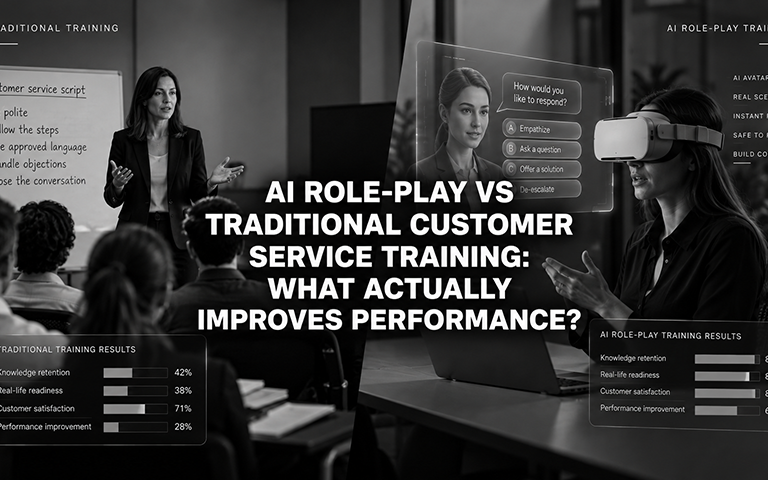
AI Role-Play vs Traditional Customer Service Training: What Actually Improves Performance?
Your company trained 200 customer service agents. Everyone completed the course. Everyone passed the assessment.
Three weeks later, customers are still asking for supervisors. Agents are still offering unnecessary discounts to end difficult calls. And your quality assurance team is flagging the same communication mistakes.
The training was delivered. The problem survived.
So you schedule another workshop.
It’s a familiar cycle in customer service training. Companies spend money teaching employees how to handle difficult conversations, then discover that knowing the correct response doesn’t mean being able to deliver it when a customer is furious.
With AI role-play training becoming more accessible, L&D leaders and customer service directors have another option. Employees can rehearse realistic customer interactions with conversational AI, receive feedback and repeat scenarios without waiting for a trainer.
But does AI role-play actually improve customer service performance? Is it better than traditional role-play? And when does human-led training still make more sense?
Traditional customer service training: where it works and where it breaks down
Traditional customer service training combines instructor-led sessions, product education, demonstrations, group exercises and role-play.
Done well, it’s valuable.
An experienced trainer can recognise when an agent sounds dismissive despite using polite language, explain why a response damaged trust and draw on years of real customer interactions.
They can also identify problems that training alone won’t fix. Sometimes an agent struggles because the refund policy is unreasonable, the escalation process is unclear or employees lack the authority to resolve complaints.
The difficulty appears when organisations try to scale individual practice.
Thirty people attend the workshop. How many actually practise?
Picture a two-hour customer service training session with 30 employees.
The trainer introduces a framework for handling complaints. The group discusses examples, watches a demonstration and works through exercises.
Perhaps six people participate in live role-play. The rest observe.
Observation has value. But there’s a difference between watching someone manage an angry customer and finding the right words yourself while somebody interrupts you.
Now multiply that problem across 500 agents working different shifts, locations and languages.
Providing enough individual practice becomes a scheduling and resource challenge.
Human role-play has another limitation: people know they’re pretending.
Ask a colleague to play an angry customer. They might be convincing for the first minute. Then they soften their tone, laugh or accept an explanation that a real customer would challenge.
Some employees also dislike making mistakes in front of colleagues, particularly when their manager is watching.
Real customers are rarely so accommodating.
What is AI role-play training for customer service?
AI role-play training uses conversational artificial intelligence to simulate customer interactions. Employees speak with an AI character that responds to their words, allowing them to practise handling complaints, objections and unexpected questions.
Unlike a fixed script, a well-designed AI role-play scenario can change depending on what the employee says.
Imagine an agent practising with a customer whose internet service has been disconnected for the third time this month.
The customer wants an immediate solution and compensation.
The agent explains the technical issue.
The customer interrupts: “That’s what your colleague told me yesterday. Why should I believe you?”
Now the employee has to decide what to do.
Repeat the explanation? Acknowledge the previous failed promise? Offer a concrete next step? Escalate?
The simulation continues based on the response.
Afterwards, the employee can review the conversation, identify mistakes and try again.
More practice, without waiting for the next workshop
A trainer might have 45 minutes available for an individual coaching session.
An AI simulation can be available whenever an employee has time to practise, provided the organisation has made the platform accessible.
An agent can rehearse a difficult refund conversation before starting a shift. A new employee can repeat an escalation scenario after receiving feedback. A supervisor can assign targeted practice when quality reviews identify a recurring weakness.
But repetition alone doesn’t guarantee improvement.
Someone can repeat a poor response ten times and become very good at making the same mistake.
Which is why feedback matters.
AI role-play vs traditional role-play: a practical comparison
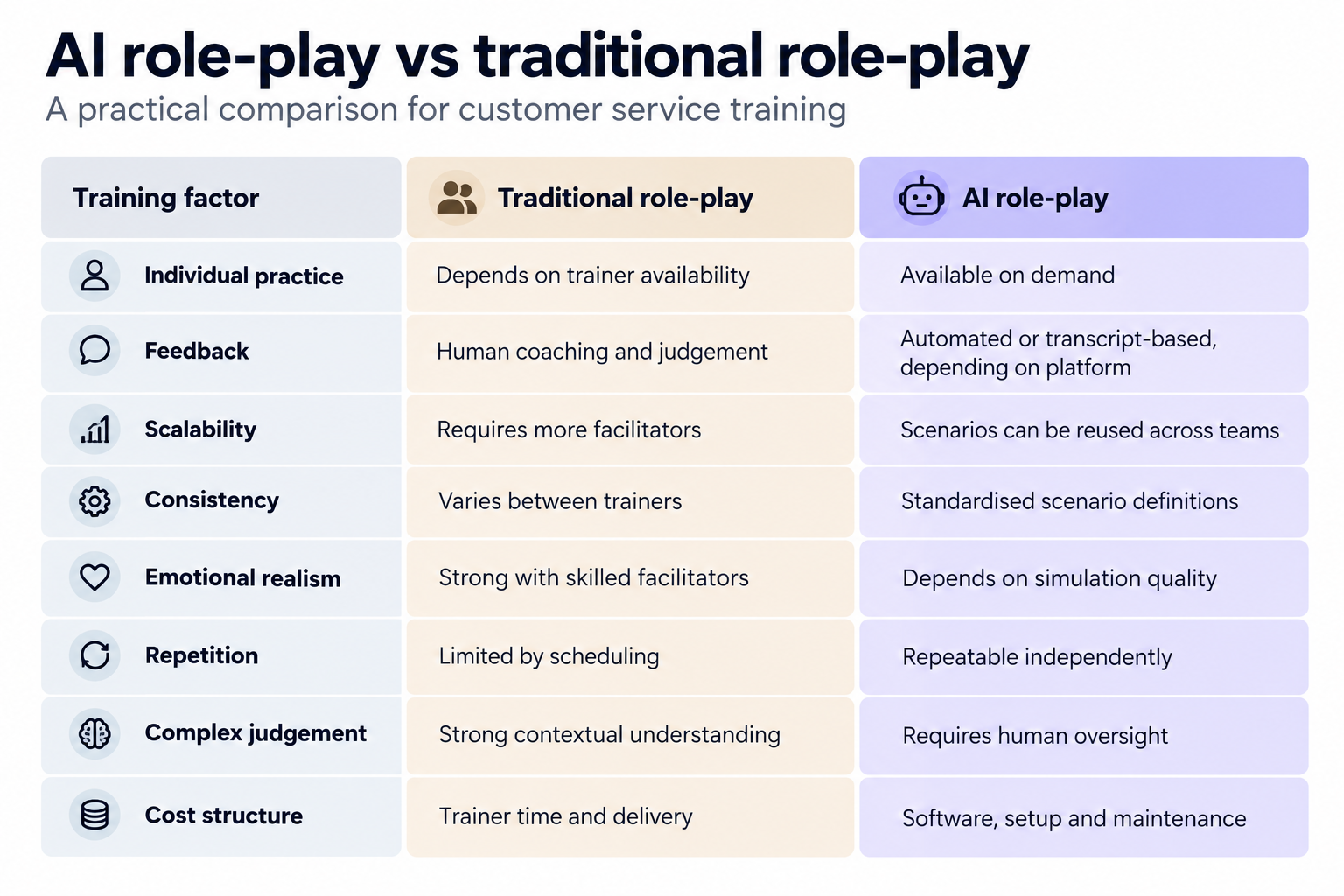
For a small team with an experienced trainer and enough time for individual coaching, traditional role-play may be entirely sufficient.
For a contact centre employing 2,000 agents across eight countries, arranging regular human-led practice is a different proposition.
AI role-play becomes particularly useful when organisations need frequent, repeatable individual training at scale.
Does simulation-based training actually improve performance?
Research provides reasons to take simulation-based training seriously, although the evidence doesn’t support treating every AI training platform as equally effective.
A study by Murthy, Challagalla, Vincent and Shervani (2008), published in Management Science, compared simulation-based training with traditional role-play in call centres at two Fortune 50 companies.
Simulation training produced better results in call accuracy and processing speed, with stronger relative benefits for more complex tasks.
Source: Murthy et al. (2008), “The Impact of Simulation Training on Call Center Agent Performance: A Field-Based Investigation”, Management Science, 54(2), 384–399.
The research predates modern generative AI, so it supports simulation-based learning rather than proving that today’s AI avatars outperform human trainers.
More recently, Al Owayyed, Tielman and Brinkman (2026) conducted a randomised controlled study involving 346 participants in child helpline counsellor training.
Simulation-based learning improved participants’ knowledge and reflective ability. Adding feedback produced further improvements in knowledge and conversational performance.
Source: Al Owayyed et al. (2026), “Simulation-based training for child helpline counsellors: Impact of simulation, feedback, and reflection in a randomised controlled trial”, International Journal of Human-Computer Studies.
However, workplace evidence for newer LLM-powered role-play remains limited.
A 2026 study published in Frontiers in Artificial Intelligence tested an LLM-based role-play system with 12 customer support employees over four weeks. The results did not establish a reliable improvement in workplace outcomes.
Source: “Preventing Escalation in Customer Service: Immediate Motivation and Four-Week Outcomes in a Workplace Deployment of LLM Role-Play Training” (2026), Frontiers in Artificial Intelligence.
Taken together, these findings suggest that realistic simulation and useful feedback can support learning.
Is AI role-play cheaper than traditional customer service training?
Consider a hypothetical contact centre with 500 employees.
If every agent receives one hour of individual human-led role-play each month, that’s 500 hours of facilitated practice.
Over a year, the organisation would need 6,000 hours of individual sessions.
At an illustrative fully loaded facilitation cost of €50 per hour, that’s €300,000 annually in facilitation time alone.
This is a simplified calculation, not an industry benchmark. It excludes preparation, administration and employee time. Many organisations also use group sessions or peer role-play instead of individual facilitation.
Still, it illustrates why frequent practice becomes expensive.
AI role-play changes the cost structure. Organisations pay for software, scenario development, implementation and oversight. Once a scenario is available, additional practice may require considerably less facilitator time, depending on the platform’s pricing model.
But a lower cost per session only matters if the training helps employees perform better.
A cheap simulation that teaches the wrong behaviour is expensive in the long run.
Where AI role-play still struggles
AI simulations have limitations that organisations need to understand before implementation.
An AI customer isn’t a real customer. Real people have personal histories, cultural expectations and emotional reactions that simulations cannot always reproduce. Employees shouldn’t learn to anticipate an AI character’s patterns instead of understanding the customer’s needs.
Automated feedback can be wrong. A system might reward a polite phrase that was inappropriate in context or fail to recognise a justified escalation. Human review and clear assessment criteria remain important.
Poor scenarios create poor training. A generic instruction to “act like an angry customer” isn’t enough. Useful simulations need realistic customer situations, company policies, behavioural objectives and clear boundaries around what employees are authorised to offer.
Customer data needs protection. Organisations using real complaints to build scenarios must consider privacy, information security and how sensitive information is handled.
A convincing avatar alone doesn’t make a good training programme.
When should you choose traditional training, AI role-play or both?
The decision depends on the skills employees need to develop.
Human-led training works particularly well when employees need nuanced coaching, discussion of ethical dilemmas or help understanding complex organisational situations.
AI role-play is useful when employees need repeated practice handling complaints, responding to objections, managing frustration or applying established procedures under pressure.
For large customer service operations, combining both approaches may be the most practical option.
A trainer introduces the skill and explains what good performance looks like. Employees practise individually through simulations. The trainer reviews selected conversations, addresses recurring weaknesses and adjusts the training.
This also gives trainers more time to focus on employees and situations that genuinely require their expertise.
How do you measure whether AI role-play training works?
Before introducing a new training method, decide what success should look like.
If agents frequently make inappropriate refund promises, training should address that behaviour.
If supervisors receive unnecessary escalations, employees should practise recognising when escalation is required and when they can resolve an issue themselves.
A useful evaluation includes four steps:
Establish a baseline. Review complaints, quality assurance results and recurring communication problems.
Assess employees before training. Use realistic scenarios and consistent criteria to evaluate observable behaviour.
Provide practice and feedback. Track whether employees improve their responses, rather than simply counting completed sessions.
Measure workplace outcomes. Examine repeat contacts, unnecessary escalations, resolution quality and relevant customer satisfaction indicators.
Where possible, compare groups receiving different training methods while accounting for differences in experience and case complexity.
A pilot programme can help organisations test AI role-play before introducing it across the entire workforce.
The number of completed simulations is a training activity metric. What employees do differently during real customer interactions is the more important outcome.
How Alterland AI Partner supports customer service training
At Alterland, we developed AI Partner to help organisations give employees more opportunities to rehearse real workplace conversations.
The platform uses photorealistic conversational AI avatars that can take on different roles through configurable scenarios.
For customer service training, an avatar might represent a customer disputing a payment, someone demanding compensation after repeated service failures or a frustrated client threatening to cancel a contract.
Scenarios can be configured around customer personas, learning objectives and the organisation’s actual communication challenges.
Session transcripts allow employees and trainers to review conversations and identify areas for improvement.
For distributed customer service teams, this makes it possible to provide consistent practice scenarios across locations without organising an individual session with a trainer every time someone needs to rehearse.
AI Partner can complement existing training programmes, including human-led coaching and assessment.
It is most useful when the organisation has a specific conversation to practise and a clear definition of successful behaviour.
Before you invest in another training programme, ask one question
How many times does each employee actually practise a difficult customer conversation before handling one alone?
Not how many training hours they’ve completed.
How many times have they had to respond to an angry customer, make a decision under pressure, receive feedback and try again?
For some teams, human-led role-play provides enough opportunities.
For others, particularly large contact centres and distributed customer service operations, AI simulations can make regular individual practice more practical.
If employees keep making the same mistakes after completing training, another course may simply give them more information they already know.
Perhaps what they need is a chance to use it.
Want to find out whether AI role-play could work for your customer service team? Explore Alterland AI Partner and see how your own training scenarios could be brought into practice.