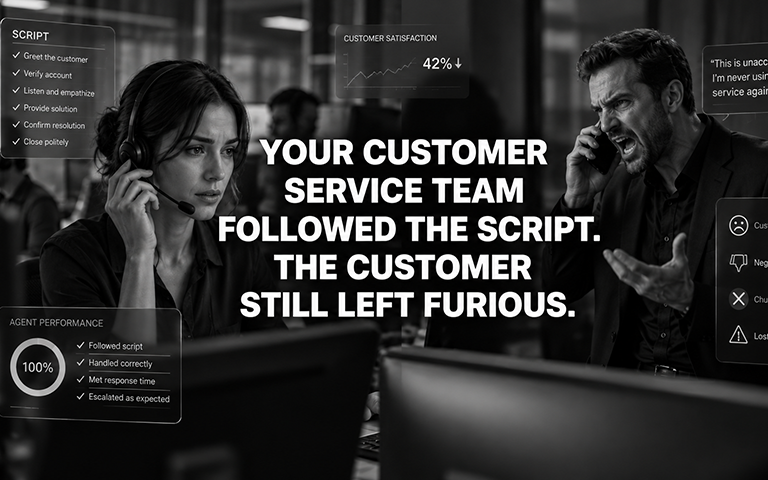
Your customer service team followed the script. The customer still left furious.
The customer called because a delivery was late. Again.
Your customer service agent apologised, explained the policy, offered the standard solution and followed every step of the approved procedure.
The customer asked to speak to a manager.
Twenty minutes later, the call had been escalated, the customer was threatening to cancel their contract, and someone from the complaints department was trying to repair the damage.
The agent hadn’t broken a single rule.
They had completed their customer service training. They knew the escalation procedure. They had passed the assessment.
So why did the conversation go so badly?
Because knowing how to handle an angry customer and actually handling one, while that person is interrupting you, questioning your competence and demanding an immediate solution, require very different levels of preparation.
And many customer service training programmes spend far more time teaching the first than practising the second.
The customer doesn’t care that your agent followed the procedure
Companies invest considerable effort in standardising customer service.
There are scripts for complaints, procedures for refunds, escalation matrices and approved language for difficult situations. Quality assurance teams review conversations against carefully defined criteria.
All of this has a purpose. Consistency matters, particularly when hundreds of agents represent the same company.
But consider what happens when an already frustrated customer hears:
“I understand your frustration. Unfortunately, according to our policy...”
The sentence may be perfectly compliant. It may also be precisely the wrong thing to say at that moment.
A customer who has explained the same problem to three different people doesn’t necessarily need another apology. They need evidence that somebody understands what’s happened and is taking responsibility for the next step.
An agent who continues repeating approved phrases can make the situation worse, even while doing exactly what their training instructed them to do.
Good customer service requires judgement. And judgement is difficult to develop through scripts alone.
Agents need to recognise when a conversation is becoming confrontational, understand what the customer is actually asking for, and respond without making promises they cannot keep.
Those skills develop through experience. Unfortunately, in many organisations, the experience comes from real customers.
Your customers are paying for the gaps in your training
Think about the first genuinely difficult call a new customer service agent handles.
They’ve completed onboarding. They’ve studied the product, learned the CRM and listened to recordings of successful conversations.
Perhaps they’ve even practised a few standard scenarios with their trainer.
Then a customer calls and starts shouting.
The customer refuses the proposed solution. They interrupt every explanation. They accuse the company of dishonesty and demand something the agent isn’t authorised to provide.
The agent knows the procedure.
What they haven’t necessarily learned is how to remain composed while somebody is challenging them personally.
So they become defensive. Or overly apologetic. Or they rush to transfer the call to a supervisor.
Sometimes they offer a discount simply to end the confrontation.
The immediate cost might be a longer call or an unnecessary concession. But the consequences can extend further: repeated contacts, supervisor workload, customer churn and public complaints.
One poorly handled conversation rarely appears as a major financial event. Across a contact centre handling thousands of interactions, however, recurring mistakes become an operational problem.
And if the same mistakes keep appearing in quality reviews, the question is worth asking: how much opportunity did those agents have to practise handling the situation before it happened?
Why traditional customer service training struggles with difficult conversations
Most organisations already recognise the importance of communication skills. Their customer service training programmes include active listening, empathy, conflict resolution and de-escalation techniques.
The difficulty comes when employees are expected to apply those concepts under pressure.
Knowing the right response is easier than finding it under pressure
During training, an agent might be asked how they should respond when a customer becomes aggressive.
They can probably explain the correct approach: remain calm, acknowledge the concern, ask clarifying questions and explain the available options.
Now put them in a conversation where the customer interrupts after every sentence.
The agent has to listen, think, manage their own reaction and decide what to say next. They must also stay within company policy.
There is no pause button.
That’s a much more demanding task than selecting the correct answer in an assessment.
Role-play helps, but opportunities are limited
Human-led role-play remains valuable. Experienced trainers can observe behaviour, challenge assumptions and explain why a particular response works.
But providing that level of individual practice becomes difficult when an organisation has hundreds or thousands of employees.
A trainer can demonstrate a difficult conversation to a group of 30 people. They cannot give all 30 participants extensive individual practice in the same hour.
Peer role-play offers another option, although employees may feel uncomfortable acting aggressively towards colleagues. Some scenarios become overly polite. Others end with everyone laughing because nobody wants to play the furious customer seriously.
Real customers are rarely so accommodating.
For a closer look at the limitations of conventional training, read Why Sales Training Doesn’t Work and What the Data Says About Fixing It. Although the article focuses on sales, the same difficulty with limited opportunities for realistic practice applies to customer service.
Training happens once. Difficult customers keep coming.
An agent might complete de-escalation training during onboarding and receive a refresher six months later.
Meanwhile, the situations they encounter change.
A new billing policy creates complaints nobody anticipated. A product issue triggers a wave of angry calls. A customer challenges a decision that agents have little authority to change.
The training material may still be accurate. The conversations have become more complicated.
For customer service teams, communication training needs to be something employees can return to whenever a new situation appears.
What effective customer de-escalation training should actually include
Customer de-escalation training prepares employees to reduce tension, understand the customer’s concern and guide a difficult interaction towards an appropriate next step.
Effective training needs to reproduce the uncertainty of a real conversation.
That means the customer shouldn’t always respond positively when an agent uses the recommended phrase.
Sometimes the customer remains angry. Sometimes they misunderstand the explanation. Sometimes the agent needs to change their approach halfway through the conversation.
Consider three common scenarios.
Scenario 1: The customer demands an exception
A customer wants a full refund outside the company’s refund policy. They’ve already spoken to another agent and insist they were promised an exception.
The employee needs to acknowledge the situation, investigate what was previously communicated and explain what they can genuinely offer.
The challenge is maintaining trust without promising something outside their authority.
Scenario 2: The customer threatens to make the complaint public
A customer says they’re going to publish the conversation online and contact the company’s CEO.
The agent must avoid becoming defensive, establish the facts and identify an appropriate resolution or escalation route.
The challenge is remaining professional when the conversation suddenly feels personally threatening.
Scenario 3: The customer refuses to listen
The customer interrupts repeatedly, rejects every explanation and demands an immediate answer.
The agent needs to regain enough structure to move the conversation forward without sounding dismissive or escalating the confrontation.
In each case, the employee may know the correct procedure.
The value of practice lies in discovering whether they can apply it when the conversation becomes uncomfortable.
How AI role-play can improve customer service training
AI role-play training allows employees to practise conversations with an AI-driven character that responds to what they say.
Instead of memorising a fixed dialogue, the employee participates in a simulated customer interaction.
The customer can question their explanation, express frustration, reject an offer or change direction depending on how the conversation develops.
This makes it possible to practise situations that would otherwise require a trainer or colleague to play the customer.
An agent who struggles to handle interruptions can repeat that particular scenario. Someone who becomes defensive when challenged can practise responding more calmly.
And an employee who makes a mistake can start again without that mistake affecting a real customer.
The important advantage is the opportunity for repetition.
A single successful role-play tells a trainer that an employee handled one conversation well. Repeated practice across different scenarios provides a better picture of how consistently they can apply the skill.
There is also a practical difference between AI role-play and traditional customer service training.
Traditional training is useful for explaining policies, demonstrating techniques and providing expert feedback. AI role-play gives employees additional opportunities to apply that knowledge in conversations where the responses are less predictable.
The two approaches can work together. A trainer identifies the behaviour that needs improvement, the employee rehearses it independently, and the trainer reviews progress.
AI simulations have limitations, of course. They need realistic scenarios, well-designed feedback and human oversight. A convincing avatar alone doesn’t guarantee useful training.
The quality of the exercise depends on how closely it reflects the situations employees encounter at work.
How do you measure whether customer service training actually works?
Course completion is easy to measure.
So is whether an employee passed a knowledge assessment.
Neither tells you enough about how they’ll handle a customer who is threatening to cancel a contract.
A more useful evaluation combines observed behaviour during practice with actual customer service outcomes.
During a simulation, trainers can assess whether an agent identifies the underlying issue, listens without unnecessary interruptions, explains options accurately and follows the appropriate escalation procedure.
In live operations, organisations can then look for changes in measures such as:
Repeat contact rate: Are customers contacting the company again about the same unresolved issue?
Escalation rate: Are agents transferring fewer cases unnecessarily, without discouraging legitimate escalations?
Quality assurance scores: Are agents demonstrating better communication and problem-solving behaviour?
Customer satisfaction: Are customers reporting better experiences after difficult interactions?
Resolution quality: Are issues being resolved correctly, without inappropriate promises or concessions?
These measures need context. An increase in escalation rate may be appropriate if agents are recognising serious issues earlier. A shorter call isn’t necessarily a better call.
To evaluate the impact of training, compare results before and after implementation, account for changes in case complexity, and examine whether improvements persist over time. Where possible, compare teams receiving different forms of training rather than assuming every improvement came from the programme.
The goal is to understand whether training improves decisions and behaviour in actual customer interactions.
This question extends beyond contact centres. Managers face similar difficulties when they need to deliver uncomfortable feedback, resolve conflict or address poor performance. We explored that challenge in Only 22% of Managers Are Engaged at Work. And We Keep Asking More of Them.
Where Alterland AI Partner fits into customer service training
At Alterland, we’ve built AI Partner to give employees a way to rehearse difficult conversations before they face them at work.
For customer service teams, that means creating simulations based on situations the organisation already knows are difficult.
A customer who refuses a refund. A frustrated caller demanding a supervisor. A client threatening to terminate a contract.
Employees can practise individually with a photorealistic AI avatar, repeat the conversation and review the session transcript to examine exactly what they said.
Scenarios can be configured using role cards that define the customer persona and the context of the interaction.
For a contact centre operating across several countries, this offers a practical way to make consistent practice scenarios available to distributed employees without scheduling an individual session with a trainer every time someone needs more practice.
Human trainers still have an important role. They understand the organisation’s culture, can interpret complex behaviour and recognise when a simulated conversation doesn’t adequately represent a real situation.
Their expertise becomes particularly valuable when designing scenarios, reviewing performance and helping employees understand why certain approaches work.
The technology makes more practice possible. The organisation still needs to decide what good performance looks like.
Before you buy another customer service training course, listen to your escalations
Take ten recent customer complaints that required supervisor intervention.
Listen to the conversations.
How many escalations were unavoidable because the agent genuinely lacked the authority to resolve the issue?
And how many became worse because of something that happened during the conversation?
Perhaps the agent interrupted too early. Perhaps they repeated a policy without addressing the actual concern. Perhaps they made a promise they couldn’t keep.
Now compare those moments with your training programme.
Do employees actually practise these situations? Do they receive specific feedback? Can they try again?
If the answer is no, another presentation about empathy probably won’t solve much.
Your team may already understand what good customer service looks like.
They need more opportunities to demonstrate it when the conversation gets difficult.
And preferably before the person on the other end of the line is a real customer.
Want to see how your team could practise difficult customer conversations? Explore Alterland AI Partner.