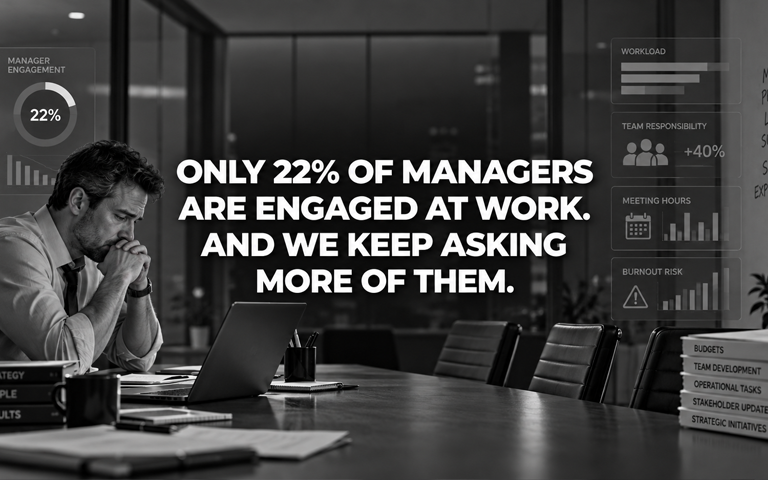
Only 22% of managers are engaged at work. And we keep asking more of them.
Your best salesperson gets promoted.
Or your strongest engineer. Your most experienced consultant. The person who knows the clients, understands the business and consistently delivers.
On Friday, they’re responsible for their own performance.
On Monday, they’re responsible for other people’s.
Now they need to give difficult feedback without making someone defensive. Deal with poor performance. Handle conflict between two people they like. Tell a strong employee they’re not getting the promotion. Notice when someone is quietly checking out. Keep a difficult one-to-one from turning into an argument.
We expect managers to become good at these conversations remarkably quickly.
The numbers suggest many aren’t getting much help.
According to Gallup’s State of the Global Workplace 2026, only 22% of managers worldwide were engaged at work in 2025.
Two years earlier, that figure was 30%. In 2022, it was 31%.
Manager engagement has fallen nine percentage points in three years.
There’s a lot behind a number like that. Workload matters. Organisational change matters. Team size, expectations and the quality of leadership above the manager matter.
But there’s another question worth asking.
How well do we actually prepare people for the human part of being a manager?
Becoming a manager changes the job more than we admit
Promotion into management is often treated as the next logical career step.
Someone performs well, demonstrates expertise and earns more responsibility.
The problem is that many of the skills that made them excellent in their previous role don’t automatically transfer.
Being a great engineer doesn’t teach you how to tell another engineer their performance isn’t good enough.
Closing large deals doesn’t prepare you to mediate a conflict between two people on your team.
Knowing the business inside out doesn’t mean you’ll know what to say when a high performer tells you they’re thinking of leaving.
These are learnable skills.
But knowing a framework and using it while another human being is disappointed, angry or defensive are two very different levels of competence.
Gallup has previously found that only 48% of managers strongly agreed they had the skills needed to be exceptional at their job. Its more recent research also says that fewer than half of managers worldwide have received management training.
We give people responsibility for other people’s performance, motivation and development.
Then quite often, we leave them to learn the difficult parts while doing the job.
Most management training teaches knowledge. Management happens in conversations.
There is nothing wrong with learning a feedback model.
Managers should understand how to set expectations, structure feedback, coach employees and address performance problems.
The difficulty begins when the slide deck ends.
Imagine you’ve just completed a course on difficult conversations.
You know the framework.
Then an employee sits down opposite you and says:
“I don’t agree with any of this.”
Now what?
They interrupt you.
They challenge your examples.
They become defensive.
Or worse, they say almost nothing.
The conversation you rehearsed in your head has disappeared within thirty seconds.
This is where management becomes behavioural rather than theoretical.
You have to listen while thinking.
Choose your words.
Notice the reaction.
Decide whether to push or pause.
Ask another question.
Keep the conversation productive without avoiding the difficult part.
You don’t develop that ability by reading about it.
You develop it through practice.
Difficult conversations are a skill. Skills need repetition.
We accept repetition as obvious in many other areas.
Nobody would expect someone to become good at public speaking after reading a presentation about public speaking.
A pilot doesn’t learn emergency procedures for the first time during an emergency.
A professional athlete doesn’t hear the coach explain a movement once and consider the skill mastered.
Yet workplace conversations are often treated differently.
A manager attends a workshop.
Perhaps there’s a role-play.
They practise one scenario, once, often with another manager who already knows what the exercise is trying to achieve.
Then everyone returns to work.
The next repetition happens with a real employee.
That’s an odd place to practise.
Why traditional role-play is difficult to scale
Human role-play can be extremely useful.
A skilled trainer can observe nuance, challenge the participant and give detailed feedback. Practising with colleagues can create discussions that no automated system will reproduce exactly.
The problem is repetition.
Suppose 400 managers need to practise a performance conversation individually.
One 30-minute attempt per person already means 200 hours of practice time, before trainer feedback, preparation or a second attempt is included.
And one attempt isn’t much practice.
If each manager needs to try the scenario five times, the logistics become considerably harder.
There is also consistency.
One participant gets a challenging role-play partner.
Another gets someone who makes the conversation easy.
One trainer focuses on questioning technique. Another notices tone. A third spends more time on the structure of the conversation.
None of this makes human training bad.
It makes individual behavioural practice difficult to provide frequently and consistently at scale.
The conversations managers rarely get to practise
Think about the conversations a manager may need to handle during an ordinary year:
A good employee wants a promotion that isn’t available.
Someone’s performance has dropped and they don’t see the problem.
Two colleagues are in conflict.
A team member reacts badly to critical feedback.
Someone wants a salary increase the manager cannot approve.
A previously reliable employee has become disengaged.
A new hire isn’t meeting expectations.
A high performer says they’ve received another offer.
An employee starts crying.
Someone gets angry.
Someone simply shuts down.
These situations aren’t rare enough to ignore.
But each individual scenario may happen too infrequently for a manager to build confidence through experience alone.
And when it does happen, the stakes are real.
You can’t say:
“Sorry, that wasn’t a very good attempt. Can we restart from the beginning?”
What if managers could practise the same conversation five times?
This is where AI role-play becomes interesting.
Not because managers need another AI tool.
They already have plenty of those.
The useful part is repeatable conversation practice.
Give a manager a realistic scenario.
For example:
An employee has missed several targets but believes expectations were unclear.
The manager has to address the performance issue, understand the employee’s perspective and agree on what happens next.
Now let them have the conversation.
The employee pushes back.
The manager over-explains.
The conversation drifts.
Start again.
On the second attempt, the manager asks better questions but avoids stating the performance problem clearly enough.
Again.
By attempt four, they’ve heard several possible reactions and tried different ways of responding.
The fifth conversation isn’t guaranteed to be perfect.
But it isn’t their first one anymore.
That difference matters.
AI role-play isn’t the same as asking ChatGPT what to say
This distinction is important because “AI training” can mean almost anything now.
Asking an AI assistant:
“How should I give an employee difficult feedback?”
can produce useful advice.
It can suggest a structure, point out common mistakes and help draft language.
That’s knowledge support.
Role-play is different.
The manager has to respond in real time to another side of the conversation.
A well-designed AI role-play scenario can be built around a specific employee persona, business context, objective and expected behaviours. The virtual employee can challenge what the manager says, ask questions or respond differently depending on how the conversation develops.
The manager isn’t receiving an answer.
They’re practising producing one.
The scenario matters more than the AI
This is where organisations can easily get distracted by technology.
A photorealistic avatar is impressive.
A natural voice matters.
Good conversational AI matters.
But none of those things can rescue a badly designed training scenario.
If the exercise is simply:
“Practise giving feedback to an employee,”
there isn’t enough context.
What happened?
How serious is the problem?
What does the employee believe happened?
What has already been discussed?
What should the manager achieve?
Which behaviours are being assessed?
What would a poor conversation look like?
What would a strong one look like?
Useful practice starts with the situation.
Technology comes later.
AI shouldn’t replace the management training around the practice
There is another tempting mistake here.
If AI can simulate conversations, why bother with trainers, coaches or management programmes?
Because practice is only one part of development.
Managers still need to understand what good management looks like. They need frameworks, organisational context, feedback and opportunities to reflect on what happened.
Some situations also benefit enormously from human coaching.
AI role-play solves a narrower problem:
How do we give many people enough individual repetitions before the real conversation happens?
That’s a useful problem to solve precisely because human training time is valuable.
Instead of using an experienced trainer to play the same employee 200 times, organisations can use that expertise to define the scenario, identify the behaviours that matter, review results and coach where human judgement adds the most value.
This is where we use AI Partner at Alterland
AI Partner was built around this idea of repeatable practice.
An organisation can create scenarios based on situations its people actually face: performance conversations, manager feedback, customer escalation, interviews, sales objections or onboarding conversations.
Employees practise individually with an AI-driven character on desktop or in VR, repeat the scenario and receive structured feedback.
The interesting part for us isn’t replacing a leadership programme with AI.
It’s what can happen between learning the framework and using it on a real person.
That gap is where practice belongs.
Not every management conversation needs a simulation
If a manager needs to understand a new company policy, send them the policy.
If they need a framework for setting goals, teach the framework.
If they need advice on a specific situation, a conversation with their own manager or an experienced coach may be far more useful.
AI role-play starts to make sense when the organisation has a repeatable behavioural situation that many people need to handle well.
Especially when mistakes are costly.
Especially when people need more than one attempt.
And especially when providing those attempts with trainers or actors would be difficult to scale.
That’s a much more useful test than asking whether a company “should use AI for leadership training.”
The first difficult conversation shouldn’t be the real one
The 22% engagement figure doesn’t have a single cause, and practising difficult conversations isn’t going to fix manager engagement on its own.
It would be dishonest to pretend otherwise.
Managers need reasonable workloads, good leadership, clarity, support and development. Gallup’s research repeatedly points to the importance of manager training and ongoing development.
But development needs to prepare managers for what the job actually asks them to do.
And much of management happens in conversations where there is no script.
We already know how to teach people the theory.
The next question is whether we’re giving them enough opportunities to practise what happens when the other person doesn’t follow it.
Because the employee sitting across the table shouldn’t have to be the manager’s first role-play.
Sources: Gallup, State of the Global Workplace 2026; Gallup research on manager development and workplace learning.