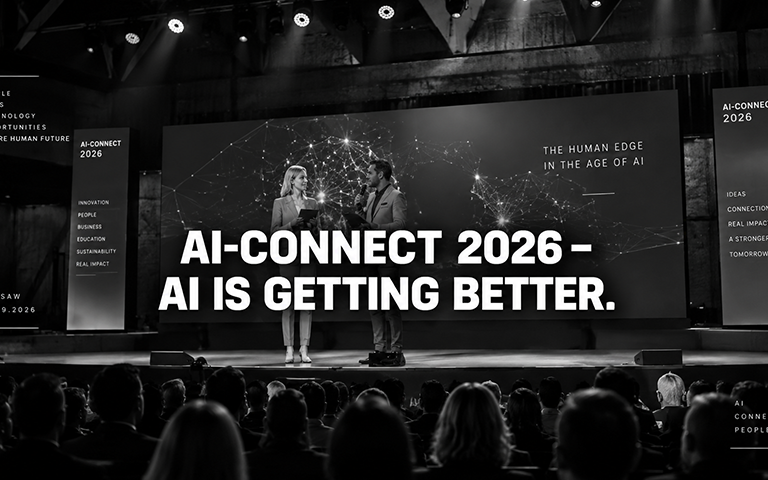
AI-Connect 2026 - AI is getting better. What should people get better at?
AI can already write the email, summarise the meeting, analyse the spreadsheet, generate the image and answer the customer.
Give it another six months and this opening paragraph will probably need updating.
But after a full day of conversations about artificial intelligence at AI-CONNECT 2026 in Szczecin, one question stayed with us longer than any list of new capabilities:
What becomes more valuable when AI can do more?
That was also close to the idea behind this year’s conference: The Human Edge in the Age of AI. On September 23, business leaders, researchers and technology practitioners met at the Szczecin Philharmonic to talk about AI in business, cybersecurity, digital transformation and the role people still play as automation moves deeper into everyday work.
Alterland joined AI-CONNECT 2026 as a Premium Partner, and our Founder & CEO, Dorota Sędek, took the stage with a title designed to get people thinking:
“My Son Wishes AI Didn’t Exist. His Mother Builds It.”
It worked.
The AI conversation has moved on
A few years ago, most business conversations about artificial intelligence started with the same question:
What can AI do?
That question isn’t particularly difficult anymore. The list gets longer every month.
Companies are already using AI to automate processes, analyse data, support customer experience, generate content, write code and help employees make decisions. The programme at AI-CONNECT reflected that shift, moving between practical AI implementation, cybersecurity, digital sovereignty, leadership and organisational transformation.
The more interesting questions now sit somewhere else.
Which decisions should still belong to people? Which skills become more important when routine work is automated? How do you introduce AI without slowly removing judgement from the job? And how do people learn to work with systems that are improving faster than most corporate training programmes can keep up?
There are no neat answers to those questions. Which is probably why they’re worth discussing.
“My Son Wishes AI Didn’t Exist. His Mother Builds It.”
The title of Dorota’s talk was designed to provoke. And it did.
But behind it was a much broader question than whether AI is good or bad.
What happens to us as technology gets better at doing more of the things we do today?
AI is entering work, education and everyday life faster than most of us have had time to properly process. Alongside the excitement, there are reasonable concerns about what we might lose along the way: skills we stop practising, decisions we hand over too easily, or human interactions we decide are more efficient when automated.
For companies building and implementing AI, those questions are worth taking seriously.
Progress isn’t measured only by what the technology can do next. It also requires deciding where technology genuinely helps people do something better, and where the human part of the work is still worth protecting.
Human-centric AI needs to mean something in practice
“Human-centric AI” sounds good on a conference slide.
It becomes more interesting on Monday morning.
A company introduces an AI tool to make employees more productive. Six months later, people may be spending part of that saved time checking what the tool produced, learning another system or figuring out which decisions they can safely delegate to it.
This is where implementation matters as much as capability.
What is the system supposed to improve? What will employees do differently because it exists? Where does human judgement remain necessary? What happens when the AI is wrong? Who owns the final decision? Which skills become more important when part of the old job is automated?
Less exciting than a live demo, perhaps.
Much harder to ignore once the technology is actually inside the organisation.
Some human skills become more important when AI enters the room
Take a manager preparing to give difficult feedback.
AI can help structure the conversation. It can suggest questions or help the manager prepare for different reactions.
Then the employee sits down.
They disagree with the feedback. They become defensive. They ask something the manager wasn’t expecting.
The manager still has to listen, read the situation and decide what to say next.
The same applies to a salesperson dealing with an objection, a recruiter interviewing a candidate or a customer service employee trying to calm down an angry client.
These are skills built partly through knowledge and partly through experience. And experience is difficult to shortcut.
AI, however, can give people a safer place to build some of it.
What if AI helped us practise instead of simply doing more for us?
This is one of the applications of artificial intelligence we’re particularly interested in at Alterland.
A manager can rehearse a difficult performance conversation before having it with an employee.
A salesperson can face the same objection several times and see what happens when they change their response.
Someone working with customers can practise an escalation without an actual customer being on the receiving end of their first attempt.
With AI Partner, the AI plays the other side of the conversation. The employee gets to practise, make mistakes, start again and build confidence before the situation carries real consequences.
The useful outcome is fairly simple: the real conversation isn’t attempt number one.
For us, that’s a practical example of human-centric AI. Technology creates more room for a person to develop a skill they will still need themselves.
The same principle goes beyond AI
Our conversations in Szczecin weren’t limited to AI Partner.
At Alterland, we work across AI, VR collaboration and digital twins. The technologies are different, but the business questions behind them often overlap.
A digital twin can give someone access to an industrial machine that is thousands of kilometres away or hasn’t been built yet.
A virtual workspace can bring a distributed team into a shared environment without requiring everyone to travel.
AI role-play can give hundreds of employees individual conversation practice without requiring hundreds of hours of one-to-one role-play with trainers.
In each case, the technology is useful because it removes a specific limitation: distance, physical access, risk, cost or the difficulty of scaling individual practice.
That gives us a fairly simple test for new technology.
If the strongest reason for implementing something is still “because it’s AI” or “because it’s VR”, the business case probably needs another look.
The human edge isn’t a competition with AI
One of the easiest ways to frame the AI discussion is as a competition.
Humans on one side. Machines on the other.
Which jobs will AI take? Which tasks will humans keep? What can people still do better?
It’s understandable, but it can also narrow the conversation.
The more useful question for organisations is what people should be able to do with increasingly capable technology around them.
If AI handles more routine preparation, perhaps a manager has more time for the conversation itself.
If a digital environment removes the need to transport a physical machine, an engineer can spend more time helping the customer understand it.
If an AI role-play partner makes practice easier to access, a trainer can spend less time repeating the same scenario and more time working with people who need deeper coaching.
Technology changes the distribution of work.
What happens next depends on the choices organisations make around it.
One day in Szczecin, plenty to take home
AI-CONNECT brought together people looking at artificial intelligence from very different angles: business, leadership, technology, cybersecurity and digital transformation.
That breadth was probably one of the most useful things about the day.
When you spend a lot of time building technology, it’s easy to become absorbed in what is technically possible. Conferences are useful when they interrupt that thinking with questions from people who have to actually use, implement, manage or live with what gets built.
Will this make someone’s work better?
What will they need to learn?
What are we automating, and why?
What should remain human?
Those questions are going to become more important as AI gets better.
Thank you to the AI-CONNECT team, everyone who joined Dorota’s talk and all the people who stopped to talk with us in Szczecin.
We came home with plenty to think about.