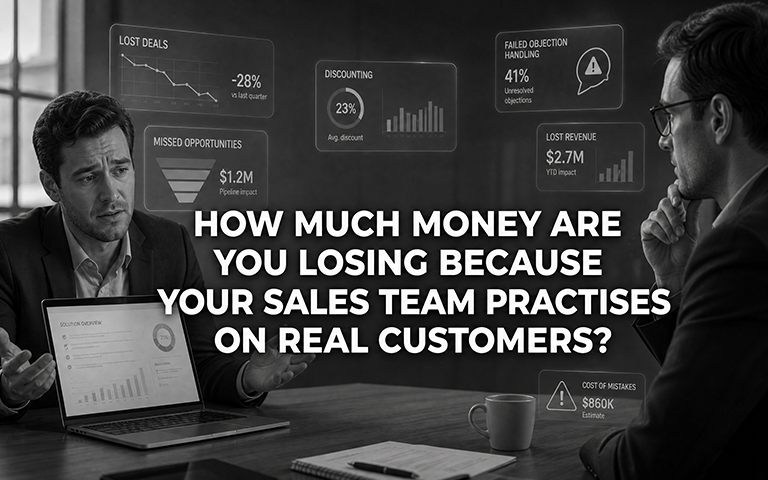
How much money are you losing because your sales team practises on real customers?
Your Sales Team Is Practising on Your Customers. That’s an Expensive Way to Learn.
Most companies would never let a new machine operator learn by experimenting on live equipment. Yet sales teams do the equivalent every day.
A new rep learns the product. Reads the sales playbook. Watches a few recorded calls. Sits through training. Maybe does a role-play with their manager.
Then a real prospect gets on the call.
“You’re too expensive.”
“We already have a supplier.”
“Just send me the information.”
And suddenly, this is the practice session.
Except the person on the other side has a budget, a problem and a very real option to buy from somebody else.
Sales training has a repetition problem
Knowing what to say and being able to say it under pressure are two different skills. This is particularly obvious in objection handling.
A salesperson can know perfectly well how the company wants them to respond to a price objection. That knowledge becomes much less useful when the objection arrives halfway through a difficult conversation with a prospect who sounds impatient.
Good responses need to become available quickly. Naturally. Without mentally searching through slide 37 of last month’s training deck.
That takes practice. And usually much more of it than companies can provide.
Human role-play is useful, but expensive to scale. A manager responsible for 20 people cannot realistically run dozens of individual practice conversations every week. An L&D team rolling out training to 400 salespeople has an even bigger problem.
So practice gets compressed into a workshop. Two people volunteer. Everyone else watches. Then everyone goes back to work.
One role-play isn’t sales practice
Consider how we learn almost anything else that requires performance. A pianist doesn’t rehearse a difficult section once. An athlete doesn’t practise a movement twice and then wait for competition. Pilots certainly don’t discuss an emergency procedure in a PowerPoint presentation and call themselves prepared.
They repeat it.
Sales conversations rarely get the same treatment, even though one badly handled conversation can cost considerably more than another hour of training.
The obvious reason is economics.
Individual practice with an experienced sales trainer or manager takes someone’s time every single time a salesperson wants another attempt. And people need different numbers of attempts.
One rep may handle the scenario well after three conversations. Another may need twelve. Traditional group training struggles with that difference because the programme has to move on.
The customer doesn’t care how many attempts the rep needed. They only experience the final one.
AI role-play changes the economics of practice
AI sales role-play removes one of the biggest constraints: another human doesn’t have to be available every time somebody wants to practise. A salesperson can run the same objection-handling scenario repeatedly. They can try a different response.
Get it wrong.
Start again.
Try a more aggressive customer.
Practise in another language.
Do it again tomorrow.
That matters because the objective isn’t to produce one impressive conversation during a training session. The objective is to build enough familiarity that the behaviour survives contact with a real customer.
At Alterland, AI Partner uses photorealistic conversational AI avatars to run these scenarios on desktop or in VR.
The scenario can be based on the company’s actual sales methodology, customer personas, learning objectives and scoring criteria.
That last part matters.
Generic AI conversation practice can produce an interesting conversation. Enterprise sales training needs something more specific: does this person handle this situation according to the way our organisation expects it to be handled?
Sales onboarding is where the gap becomes expensive
The problem becomes particularly visible with new hires.
Companies invest heavily in recruiting salespeople and then need them productive as quickly as possible. During ramp-up, new reps have to learn products, processes, systems, customer profiles, competitors, pricing and the company’s sales methodology. But eventually they have to talk to people. There is no shortcut around that.
The question is whether the first ten difficult conversations happen in training or in the pipeline. AI role-play gives sales enablement teams another option. New reps can practise discovery calls, objection handling and customer conversations before those interactions carry commercial consequences.
Managers can then spend their limited coaching time where it is actually useful rather than acting as a role-play partner for every repetition.
The same problem exists outside sales
Sales makes the cost easy to see because a lost conversation can become a lost deal. But organisations contain plenty of other conversations people are expected to handle well without getting much opportunity to practise them.
A new manager giving difficult feedback for the first time.
A customer service employee dealing with an angry customer.
A team leader addressing poor performance.
A recruiter conducting a difficult interview.
An employee explaining an unpopular decision.
Reading a framework helps.
Watching somebody else do it helps.
Neither creates the experience of having another person respond unpredictably to what you just said.
Conversation is a performance skill.
Performance skills need rehearsal.
Where AI conversation training actually makes sense
AI role-play isn’t useful because a company wants to “use AI in training”. That isn’t a training objective. It becomes useful when there is a specific, repeatable conversation that a meaningful number of people need to handle consistently.
For example:
sales teams responding to the same objections;
new sales hires practising discovery calls;
managers learning to give feedback;
customer service teams practising de-escalation;
recruiters improving interview conversations;
teams preparing for a product launch across several markets.
Start with the conversation. Then ask how many people need to get better at it, how often they currently practise and what happens when they get it wrong. The technology comes later.
Your customers shouldn’t be the training environment
Nobody becomes good at difficult conversations by reading about difficult conversations. Eventually, they have to speak. They have to hesitate. Choose the wrong answer. Hear the reaction. Adjust. Try again. The only question is where you want those first attempts to happen. If your answer is “with the customer”, you’re already paying for training. You’re just paying for it in the pipeline.