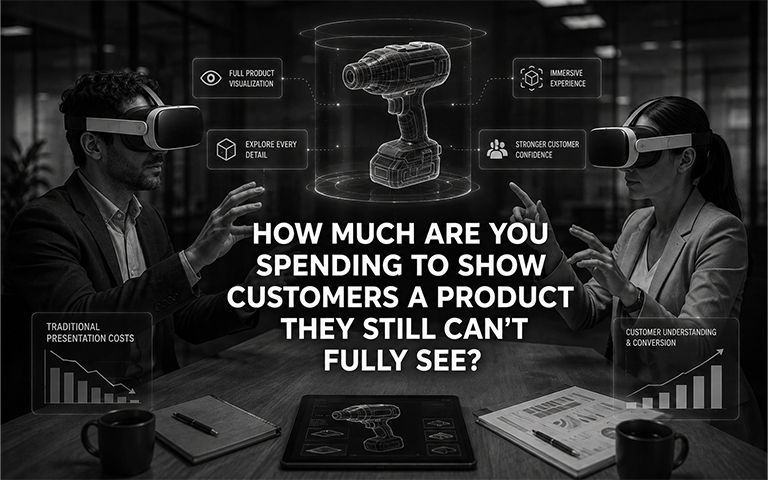
How much are you spending to show customers a product they still can’t fully see?
Some products are easy to sell at a trade show. Put them in a box. Ship them to the venue. Build the stand. Let customers see what they’re buying.
Then there are industrial machines. They weigh several tons. They require specialist transport. They take days to install. Sometimes bringing the actual product to a conference isn’t expensive. It’s impossible so the sales team arrives with the alternatives: brochures, videos, CAD images. A screen showing a beautifully produced 3D animation of a machine that, in reality, is the size of a small building. The customer watches it on a 27-inch monitor. “Can I see what’s happening inside?” Someone starts looking for another video.
Industrial sales has a demonstration problem
The more complex the product, the more important it becomes for the buyer to understand what they’re actually buying. Unfortunately, complex industrial products are often the hardest things to demonstrate.
Heavy machinery may be operating at a customer’s site hundreds of kilometres away. A production line can’t be removed from the factory for a sales presentation. A new machine may still be under construction. A facility may exist only in BIM or CAD files.
Even when the physical asset is available, access may involve travel, safety procedures, downtime or disruption to operations. This creates an odd situation. Companies can spend millions engineering an extremely sophisticated product and then sell it using PDFs.
A video can show a machine. It can’t give you scale.
Video is useful. So are renders and technical drawings. But they answer a particular kind of question: what does it look like? Industrial buyers often need answers to very different questions. How large is this component in relation to the operator? Where is the access point? Can maintenance staff reach this part? What happens inside the machine during this process? Where would this equipment fit inside our facility? What will our operators actually see? Those questions are spatial.
A flat image can communicate dimensions. Experiencing something at its real scale communicates them differently. This is where a digital twin can become useful long before the asset is connected to live operational data.
What is a digital twin for industrial sales?
The term digital twin gets used for everything from sophisticated IoT systems to fairly ordinary 3D models, which hasn’t helped anyone.
For industrial sales and product demonstrations, the useful starting point is simpler: a detailed digital replica of the physical asset that a customer can explore on desktop or in VR.
They can walk around the machine. Look inside it. Inspect components. See a process from an angle that might be physically impossible in the real product. And in VR, experience it at its actual scale. For a machine manufacturer attending international trade shows, that changes what has to travel. The machine stays where it is. Its digital counterpart goes with the sales team.
One showroom can travel everywhere
Consider a company selling large industrial equipment across Europe, North America and Asia. The traditional demonstration options aren’t particularly attractive. Bring prospects to the factory. Transport selected machinery to major exhibitions. Build physical demonstration models. Rely on video for everything else. Each option introduces some combination of cost, logistics and compromise.
A virtual machine showroom removes much of that dependency on the physical asset. A sales rep can take a headset to a conference in Germany, then use the same digital asset for a customer presentation in Singapore. A prospect who cannot use VR can access the experience on desktop.
The product hasn’t moved. The sales conversation has.
The asset can explain more than its exterior
This is where digital twins become more interesting than a photorealistic product visualisation. An industrial product often has important things the customer cannot normally see.
Internal components. Airflow. Mechanical sequences. Safety zones. Different configurations. Maintenance procedures. Data attached to specific parts of the machine. A digital environment can make those things visible in context.
Instead of pointing at a dashboard on one screen and a machine diagram on another, information can be connected to the part of the asset it describes. And the same model created for sales does not necessarily have to stop being useful after the deal. Depending on how it is built, it can become a foundation for operator training, maintenance procedures, commissioning rehearsal or operational simulation.
Digital twins also solve the “it doesn’t exist yet” problem
There is another category of product that’s particularly difficult to demonstrate. The one you haven’t built.
Property developers know this problem well. So do manufacturers selling custom installations and companies planning new industrial facilities.
Stakeholders are asked to make expensive decisions based on floor plans, technical drawings, renders and their own ability to mentally reconstruct a three-dimensional environment.
Some people are good at that. Many aren’t. Walking through an unbuilt asset creates a very different conversation. A client can notice that a space feels smaller than expected. An engineer can question access to a component. An operator can spot something inconvenient.
A decision that would otherwise happen after construction can happen before it. That is where visualisation starts becoming a business tool rather than an impressive picture.
When a digital twin is probably overkill
There are plenty of products that do not need one.
If the asset is easy to transport, easy to demonstrate and simple enough to understand from conventional material, building a digital replica may add very little.
The business case becomes stronger when the physical product is large, expensive to move, remote, dangerous to access, difficult to understand from 2D material or not built yet.
The important question isn’t whether a digital twin would look impressive at your next conference. It probably would. Ask what the current inability to show the real asset is costing you.
How many customer visits require factory travel? How many trade shows happen without the product? How often does a prospect struggle to understand scale or configuration? How expensive is it to build physical demonstration environments?
That’s where the calculation starts.
Your biggest product may fit in your carry-on luggage
The irony of industrial sales is that the products most worth seeing are often the products least able to travel.
That limitation used to be physical. It doesn’t have to be anymore.
At Alterland, we build photorealistic digital twins using NVIDIA Omniverse, OpenUSD and Unreal Engine 5, accessible through desktop and VR. The model can start as a visualisation and grow into training, simulation or a data-connected operational environment when the business case requires it.
For the sales team heading to the next conference, though, the first benefit can be much simpler.
They finally get to bring the product with them.