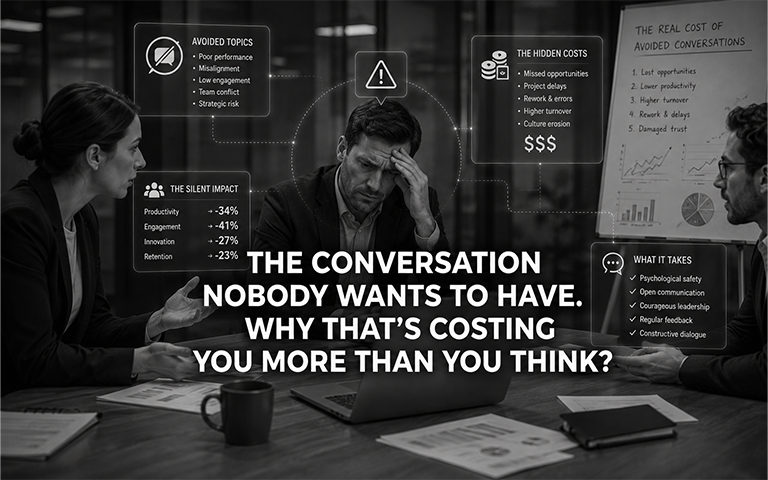
The Conversation Nobody Wants to Have. Why That’s Costing You More Than You Think?
On avoidance, management performance, and the skill most leadership development programmes quietly skip.
Ask any experienced manager to name the part of their job they find hardest, and the answer is rarely strategy or budgets or stakeholder politics. It’s the conversations.
Telling someone their work isn’t good enough. Addressing behaviour that’s affecting the team. Giving feedback that the other person won’t want to hear. Pushing back on a decision from above when you know it’s wrong. These are the moments that separate managers who develop people from managers who manage around problems until the problems become crises.
Most managers avoid them. Not because they don’t know they should have them - but because they genuinely don’t know how.
Avoidance Is a Strategy. A Bad One.
There’s a version of conflict avoidance that gets dressed up as emotional intelligence. Give people space. Don’t be confrontational. Pick your battles. These are reasonable principles when applied correctly. They become organisational dysfunction when they’re used to justify never having the conversation at all.
The cost of avoidance is rarely visible in the moment. A performance issue that goes unaddressed doesn’t announce itself as a management failure - it just continues, slowly, until it becomes a team problem, then a client problem, then an HR problem. By the time the organisation is paying attention, months have passed and the situation is significantly harder to resolve than it would have been at the start.
A VitalSmarts study of more than 650 people - VitalSmarts is now Crucial Learning, the organisation behind the Crucial Conversations methodology - found that employees waste an average of $1,500 and a full eight-hour workday for every crucial conversation they avoid (Crucial Conversations: Tools for Talking When Stakes Are High, Patterson, Grenny, McMillan, Switzler). The costs are concrete: wasted time, rework, stalled decisions, and talent lost to avoidable departures. Multiply that across a leadership layer of fifty managers, each avoiding two or three conversations a year, and the number becomes a serious line item - one that never appears on any budget because nobody is tracking it.
Why Managers Avoid Difficult Conversations
Understanding the avoidance pattern requires being honest about what makes these conversations hard - because it isn’t laziness or indifference. Most managers who avoid difficult conversations care deeply about the people on their teams. That’s part of the problem.
The fear is specific. It’s the fear of damaging a relationship that matters. Of saying the wrong thing and making the situation worse. Of the other person’s reaction - tears, defensiveness, silence, anger - and not knowing how to handle it. Of being seen as the bad guy in a story that will be retold in ways you can’t control.
These are not irrational fears. Difficult conversations can go badly. Relationships can be damaged. Feedback can land wrong even when it’s given well. The problem isn’t that managers fear these outcomes - it’s that fear of the worst case leads to a default of doing nothing, which produces its own set of outcomes, rarely better.
What’s missing isn’t motivation. It’s capability. Most managers have never had serious practice at difficult conversations under realistic conditions. They’ve attended a workshop, perhaps. Read a book. Been coached on a framework. None of which prepares you for the moment when you’re sitting across from someone and can feel the conversation starting to go sideways, and you have to decide in real time what to say next.
The Practice Gap - Again
This is the same problem that undermines sales training, onboarding, and most leadership development: the gap between knowing what to do and being able to do it under pressure.
Difficult conversation skills are not conceptual. They’re procedural - built through repetition, feedback, and the gradual accumulation of experience that makes the right response available instinctively rather than effortfully. A framework for giving feedback is useful. Having given that feedback forty times in conditions that felt real is what actually changes behaviour.
The traditional answer to this is role-play. And role-play works - when the conditions are right. In practice, the conditions are almost never right.
Put two managers in a room and ask one to play the difficult employee. Both people know it’s fake. The person playing the employee pulls their punches because they don’t want to make their colleague uncomfortable. The person giving feedback plays it safe because they don’t want to look bad in front of a peer. The scenario stays easy. The learning stays shallow.
Add an audience - which is what most group training does — and the dynamic gets worse. People perform competence rather than practise incompetence, which is exactly what productive learning requires. Nobody tries the thing they’re not sure about when being watched by colleagues who will be their peers in the lift tomorrow morning.
What Happens When the Stakes Are Removed
The conditions that make difficult conversation practice actually work are: realism, repetition, and the freedom to fail without social consequence.
Realism means the other person in the conversation responds the way a real person would, not pulled punches, not a scripted easy path, but genuine pushback, defensiveness, or silence, depending on how the scenario is going. Repetition means being able to run the same conversation multiple times until the manager finds the language that works. Freedom to fail means none of this happens in front of an audience that will remember how badly the first attempt went.
These conditions are almost impossible to create with human role-play partners at scale. They’re exactly what AI Partner delivers.
A photorealistic AI avatar in VR, configured with a specific persona and scenario, the underperforming team member who deflects every piece of feedback, the senior colleague who becomes defensive when challenged, the direct report who is about to resign and hasn’t said so yet. The manager runs the conversation. The avatar responds authentically. The session is transcribed in full. And then the manager runs it again, trying a different approach, until the responses start to feel natural rather than scripted.
The social risk is gone. The realism stays. What builds is genuine capability, not familiarity with a framework, but fluency in the actual skill.
The Organisational Dimension
Difficult conversation capability isn’t just a personal development issue. It’s an organisational performance variable.
Teams with managers who can address issues directly and constructively resolve problems faster, retain people longer, and produce better results. The relationship between psychological safety, the sense that honest conversations are possible and safe, and team performance is one of the most replicated findings in organisational research. Google’s Project Aristotle identified it as the single most important factor in high-performing teams.
Psychological safety doesn’t appear by accident. It’s built through the quality of the conversations that happen when things are difficult - whether feedback is given honestly and respectfully, whether problems are addressed rather than ignored, whether managers can say the hard thing without it becoming a crisis.
That means organisations that want high-performing teams need managers who can have difficult conversations well. And managers who can have difficult conversations well need practice, real practice, not a workshop and a workbook.
A Different Way to Develop This Skill
The organisations taking leadership development seriously are moving away from the model where capability is built in a classroom and assumed to transfer to real life. They’re building infrastructure for the kind of deliberate practice that actually produces behaviour change, environments where managers can rehearse the conversations that matter before those conversations carry real stakes.
AI Partner makes this possible at scale. Any scenario, any persona, any language, available whenever the practice needs to happen, not when the calendar permits. A new manager preparing for their first serious performance conversation. A senior leader working on giving feedback to peers rather than direct reports. An HR business partner practising a restructuring announcement.
The skill is the same regardless of seniority. What changes is the scenario. And the scenario can be configured to match exactly what the person in front of you needs to practise.
The conversations that most need to happen in your organisation are almost certainly the ones that aren’t happening. The cost of that silence is real, even when it’s invisible. The capability to change it is buildable but only with the right conditions for practice.
More repetitions. Lower stakes. Better conversations when it counts.