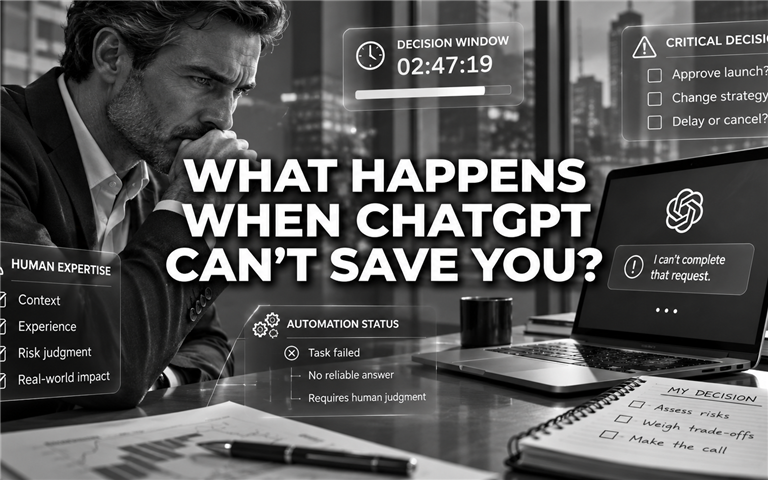
What Happens When ChatGPT Can’t Save You?
Your AI Writes Brilliant Emails. Can You Still Handle the Conversation?
A customer sends you an aggressive email. You paste it into ChatGPT, ask for a professional response and, thirty seconds later, you have a beautifully diplomatic reply.
The customer calls you five minutes later.
Now what?
There’s no time to generate three alternative responses. You can’t ask the customer to wait while you adjust the tone of your answer. You need to understand what’s happening, manage your own emotions and respond.
It’s an interesting side effect of working with artificial intelligence. The quality of our work can improve without a corresponding improvement in our own abilities.
For businesses investing in AI, that distinction deserves more attention.
Are we getting better at our jobs or better at using AI?
Imagine two employees preparing for a salary negotiation.
The first asks AI to write a persuasive argument, anticipates potential objections and memorises a few suggested responses.
The second uses AI to simulate the negotiation. They encounter resistance, struggle with a few questions and discover that their strongest argument isn’t particularly convincing when challenged.
Both employees have used artificial intelligence. Both have benefited from it.
But they’ve spent their preparation time doing very different things.
One has developed a better argument. The other has had an opportunity to become a better negotiator.
This difference matters when companies think about AI adoption and employee development. Generating a high-quality output is relatively easy to observe. Developing the human capability behind that output takes longer and is harder to measure.
The growing gap between output and ability
A well-written report used to tell you something about the person who wrote it.
So did a carefully structured sales proposal or a thoughtful response to a customer complaint.
Today, those documents may tell you just as much about the tools the employee uses.
That’s not necessarily a problem. Businesses benefit from better communication, faster preparation and fewer hours spent staring at a blank document.
The interesting question is what happens when the employee needs to defend that report, negotiate that proposal or discuss that complaint in person.
A salesperson can arrive at a meeting with an excellent AI-generated presentation and still struggle to explain why the customer should choose their product.
A manager can prepare thoughtful written feedback and still become defensive when an employee disagrees.
An executive can present a sophisticated strategy and find it difficult to answer an unexpected question from the board.
As AI makes polished content easier to produce, independent judgement and interpersonal skills may become even more important indicators of professional competence.
What happens when AI does the difficult part for us?
In their 2024 working paper, Generative AI Can Harm Learning, researchers led by Hamsa Bastani examined how access to generative AI affected students’ mathematics performance.
Students performed better during practice when they had access to AI assistance. However, those using an unrestricted AI tool performed worse than the control group when that assistance was removed. A version designed to provide learning-oriented guidance mitigated much of that negative effect.
The research concerned mathematics education, rather than workplace communication, so its findings cannot simply be transferred to corporate training.
Nevertheless, it raises a useful question for employers.
When an employee uses AI to complete a task, how much of the underlying skill are they developing?
There is a meaningful difference between asking AI to resolve a difficult problem and using AI to help you learn how to resolve it yourself.
The way companies introduce these tools could influence which of those experiences becomes more common.
What if we stopped asking AI for the right answer?
Consider a manager preparing for a difficult performance review.
The obvious way to use AI is to request a script.
The manager explains the situation, describes the employee and asks for a professional opening statement.
Within seconds, they have something useful.
But there’s another way to approach the same task.
Ask AI to play the employee.
Give the character a reason to disagree with the feedback. Let them challenge the manager’s assumptions, question the examples and raise concerns about their workload.
Suddenly, the manager has something much more interesting to work with.
They need to listen. They need to decide which questions to ask. They may discover that the opening statement they prepared doesn’t work particularly well.
And they can try again.
The same technology that can make a difficult task easier can also make a training exercise deliberately more challenging.
For learning and development teams, that is a particularly promising application of artificial intelligence.
AI could give us more opportunities to be beginners
Experienced professionals don’t often get the luxury of being inexperienced.
A sales director is expected to negotiate confidently. A manager is expected to handle conflict. A senior executive is expected to communicate effectively under pressure.
Admitting that you need to practise can feel uncomfortable, especially when your job title suggests you should already know what you’re doing.
Yet even experienced people encounter unfamiliar situations.
A manager may be excellent at developing employees but have never led a restructuring conversation.
A salesperson may have twenty years of domestic sales experience and suddenly find themselves negotiating with international distributors.
AI-powered conversation simulations create an opportunity to practise privately, without requiring a colleague to act as the other person every time.
This is one of the ideas behind Alterland AI Partner.
In virtual reality, employees interact with AI avatars representing customers, colleagues or business partners. The organisation can define the scenario around its own workplace situations.
The employee still has to conduct the conversation. The AI provides someone to practise with, rather than simply supplying the words.
For experienced professionals, that can mean having a place to experiment with approaches they might hesitate to try in a real meeting.
Should companies rethink how they measure AI adoption?
Many organisations measure the success of AI adoption through productivity.
How much time has been saved? How many tasks have been automated? How quickly can employees produce content?
These are reasonable questions.
But companies could also ask whether AI is helping employees develop capabilities that remain useful when the technology isn’t available.
Can salespeople explain complex products more clearly?
Are managers better prepared to handle disagreement?
Can customer service agents respond constructively to an unexpected complaint?
Are employees becoming more confident in situations that previously required considerable support?
These questions bring AI adoption closer to employee development.
An organisation could save hundreds of hours through automation and reinvest some of that time in developing the skills that are particularly valuable in human interactions.
That would be an interesting return on its AI investment.
The most interesting thing AI could do for your career
There’s plenty of excitement about what artificial intelligence can produce on our behalf.
And understandably so. Few people miss spending an afternoon rewriting a presentation or formatting a report.
But imagine using some of that recovered time to become a more persuasive communicator, a more thoughtful manager or a better negotiator.
Imagine having access to a practice partner whenever you’re preparing for a conversation you’ve never had before.
The next time a customer challenges your proposal, an employee disagrees with your feedback or a business partner questions your decision, you might be better equipped to respond.
Even without an AI-generated answer in front of you.
That seems like a particularly worthwhile ambition for the future of work.
At Alterland, we’re exploring how artificial intelligence and virtual reality can help people develop skills they carry into their real working lives. Discover Alterland AI Partner and the possibilities of AI-powered conversation training.