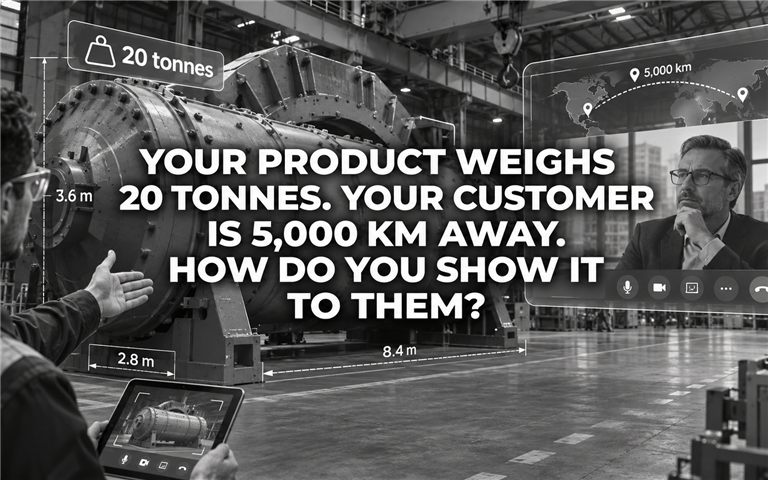
Your Product Weighs 20 Tonnes. Your Customer Is 5,000 Km Away. How Do You Show It to Them?
Industrial Sales | Digital Twin Technology | Virtual Product Demonstrations
Your sales team has finally secured a meeting with a promising international customer.
The customer is interested in your machinery. They’ve reviewed the specifications, watched the promotional video and received a commercial proposal.
Now they want to see the actual product.
There’s a slight logistical complication: the machine weighs 20 tonnes and is sitting in a factory thousands of kilometres away.
You could arrange a factory visit. You could wait until the next industry exhibition. Or you could send another video and hope it answers their questions.
But what if your sales team could take the customer inside a life-sized virtual representation of the machine during their next meeting?
For manufacturers of large, complex or highly specialised equipment, digital twin technology opens up some particularly interesting opportunities in sales and marketing.
Why selling industrial equipment requires a different approach
Buying industrial machinery is rarely a straightforward decision.
Customers need to understand how the equipment works, how much space it occupies, how operators interact with it and whether it fits their existing processes.
Several people may be involved in the purchase, from procurement managers and engineers to production directors and senior executives.
Each has different questions.
An engineer wants to examine the machine’s components. A production manager is interested in accessibility and workflow. A decision-maker wants to understand the overall investment.
A product brochure can communicate specifications. A video can demonstrate selected features. A physical demonstration allows customers to explore the equipment in greater detail.
The challenge is making that experience available when and where the customer needs it.
For manufacturers selling internationally, this can mean coordinating factory visits, transporting demonstration equipment and waiting for industry events.
A virtual product demonstration gives sales teams another option.
What is a digital twin in industrial sales?
In industrial sales, a digital twin can be used as an interactive virtual representation of a physical product, machine or facility.
Depending on its design, it allows customers to explore equipment at scale, examine selected components and understand how the product fits into its intended environment.
The term digital twin also covers more advanced industrial systems connected to live operational data. For sales and marketing applications, however, the immediate value can come from accurate visual representation and interactive product exploration, without requiring real-time machine data.
Alterland Showroom Twin focuses on this customer-facing application.
It allows companies to present photorealistic digital representations of their products in virtual environments accessible through desktop computers or VR headsets.
A customer can explore a machine from different perspectives, while the salesperson guides the presentation and discusses the features relevant to that particular buyer.
For products that are difficult to transport or demonstrate remotely, this creates a new way to support the sales process.
Five ways manufacturers can use digital twins in sales and marketing
1. Demonstrate machinery without transporting it
Imagine a manufacturer selling large industrial production lines.
A prospective customer wants to understand the equipment’s dimensions, layout and accessibility before arranging a factory visit.
A virtual product demonstration can help answer those initial questions.
The customer can explore the digital representation of the production line, while the salesperson explains its configuration and discusses the customer’s requirements.
If a physical visit is necessary later, both sides can arrive better prepared, with a clearer understanding of what needs to be examined.
2. Bring your entire product portfolio to a trade show
Exhibition space is expensive, and industrial machinery takes up plenty of it.
Manufacturers often have to choose which products to bring to an event. The decision may depend as much on transport costs and available floor space as on customer demand.
What happens when a visitor asks about a machine that stayed at the factory?
With a virtual showroom, exhibitors can make a wider range of products available for demonstration.
A visitor interested in a particular machine can put on a VR headset and explore its digital representation.
The salesperson can move between different products without needing additional physical exhibition space.
Physical equipment remains valuable at trade shows. A digital showroom can extend what the company is able to present alongside it.
3. Make technical sales meetings more interactive
A customer asks whether a particular component is accessible from the rear of the machine.
The salesperson searches through a presentation, opens a technical drawing and eventually finds a photograph taken from the right angle.
It’s a perfectly familiar situation in technical sales.
An interactive digital representation can make some of these discussions easier.
Instead of relying exclusively on predefined slides or camera angles, the salesperson and customer can explore the relevant part of the product together.
The conversation can follow the customer’s questions.
For complex equipment, that flexibility can be particularly useful when several stakeholders are attending the same meeting and want to examine different aspects of the product.
4. Support distributors and international sales partners
Manufacturers working through international distribution networks face another challenge: giving local partners access to products they may rarely see in person.
A distributor might represent an entire portfolio but have only a limited selection of physical demonstration equipment.
Product training usually involves technical documentation, presentations and occasional visits to the manufacturer’s facilities.
A virtual showroom can complement these activities.
Distributors can become more familiar with the equipment and use digital product demonstrations during their own customer meetings.
The manufacturer can provide a shared visual representation of its products across different markets, while local partners adapt the sales conversation to their customers.
5. Present equipment before it reaches the showroom
Sometimes a customer wants to discuss a product that is still being developed or manufactured.
The engineering team has drawings and design files, but there is no finished machine available to demonstrate.
Where suitable design data exists, a virtual representation can help communicate the planned equipment’s appearance, dimensions and configuration.
Customers can explore the proposed product and discuss their requirements earlier in the process.
Any features that are still subject to development should be clearly identified.
Used carefully, this approach can support early commercial discussions and help customers understand what they are considering purchasing.
What could a virtual machinery demonstration look like?
Consider an illustrative example.
A European manufacturer of industrial packaging equipment is discussing a new production line with a potential overseas customer.
The customer’s procurement manager, production director and technical specialist join the meeting.
Rather than spending the entire presentation reviewing slides, the salesperson introduces a virtual representation of the equipment.
The production director explores the layout and discusses how operators would move around the machine.
The technical specialist examines selected components and asks about maintenance access.
The procurement manager raises questions about configuration and delivery.
The salesperson can guide the discussion through the virtual environment, referring to technical documentation whenever more detailed information is required.
By the end of the meeting, the customer has had an opportunity to explore the proposed equipment from several perspectives.
A physical demonstration, engineering consultation or factory visit may still follow. The virtual experience gives those next steps a more informed starting point.
Can a digital showroom reduce industrial sales costs?
The financial value of a virtual showroom depends on how the company currently demonstrates its products.
For a manufacturer that regularly transports heavy equipment to exhibitions, potential savings may come from reducing the amount of machinery shipped to selected events.
For an international sales organisation, the opportunity may involve conducting more initial demonstrations remotely and reserving factory visits for qualified prospects.
Other potential benefits include making demonstration materials available to more distributors and reusing digital product assets across sales meetings, exhibitions and training activities.
A company evaluating the investment should consider:
Equipment transport and exhibition logistics costs.
The number of physical product demonstrations conducted each year.
Travel expenses associated with customer and distributor visits.
The number of products that can currently be demonstrated.
The cost of creating, maintaining and updating digital product representations.
The business case will look different for every manufacturer.
Companies should also consider whether virtual demonstrations help customers progress through the buying process, understand products more clearly or arrive at technical meetings better prepared.
From virtual showroom to employee training
Once a company has developed a detailed digital representation of its equipment, there may be opportunities to use related assets beyond sales.
A machine presented to customers in a virtual showroom could also form the basis of a separate training environment.
With Alterland Training Twin, companies can develop virtual experiences designed around employee training requirements.
Depending on the project, these might include equipment familiarisation, operational procedures or selected maintenance activities.
Sales and training environments serve different purposes and may require different levels of interaction and technical detail.
However, considering both applications early in a digital twin project can help companies identify opportunities to reuse relevant digital assets.
A product originally digitised for customer demonstrations could become part of a broader approach to product education.
Your showroom can travel with your sales team
Manufacturers spend years developing equipment that solves complex industrial problems.
Giving customers the opportunity to understand that equipment should be as straightforward as possible.
A virtual showroom can make products accessible beyond the factory floor, the exhibition hall and the physical demonstration centre.
For international sales teams, it means having another way to present equipment when a customer is ready to see it.
For marketing teams, it creates opportunities to showcase a broader portfolio.
For customers, it offers more freedom to explore the products they’re considering.
The machine can stay exactly where it is.
Its digital representation can join the next customer meeting.
Selling products that are difficult to transport, demonstrate or access? Discover how Alterland Showroom Twin can help you bring your industrial equipment closer to your customers.