6 Ways Companies Can Use AI Role-Play to Prepare Employees for Real Conversations
Your best salesperson has just been promoted to team leader.
Tomorrow, they need to tell a former colleague that their performance isn’t good enough. They’ve never had that conversation before.
Across the company, a new sales hire is preparing for their first negotiation. A customer service agent is learning how to handle complaints. And the export team is trying to follow one sales process across six markets, five languages and three time zones.
Different departments. Different situations. One thing in common: people need to know what to say when the conversation doesn’t go as planned.
Companies invest heavily in teaching employees what they should do. Presentations, workshops and training materials explain the processes.
But knowing the process and using it in a conversation are two different skills.
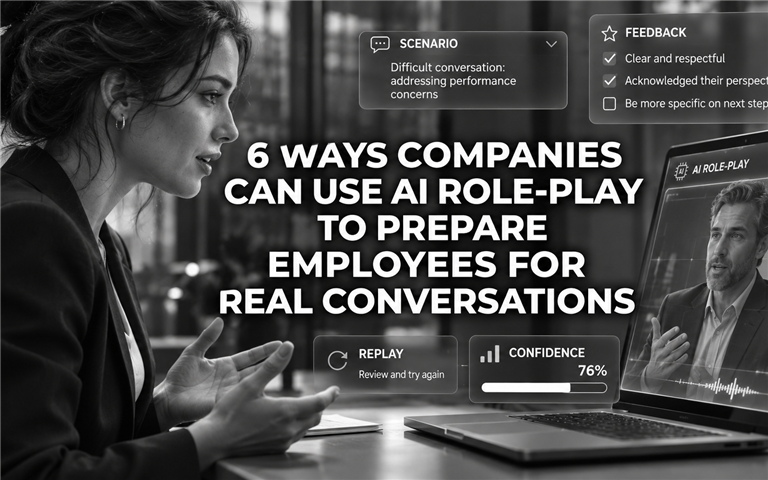
AI role-play gives employees a chance to practise realistic workplace conversations with AI characters before having them with real people.
At Alterland, we’re seeing how this approach can support different business functions. One of our clients is already using AI Partner to address the challenges of international sales training.
And the possibilities extend well beyond sales.
What is AI role-play training, and how does it work?
AI role-play training allows employees to practise conversations with artificial intelligence characters that respond to what they say.
Instead of following a fixed script, the AI character can ask questions, raise objections, express frustration or change its response based on how the employee handles the situation.
For example, a salesperson might practise a negotiation with a demanding buyer. A manager could rehearse a performance review with an employee who disagrees with the feedback.
The organisation defines the scenario, the AI character’s role and the learning objective.
Employees then practise the conversation, review what happened and repeat the exercise to improve their approach.
With Alterland AI Partner, these interactions take place in virtual reality using conversational AI avatars.
The scenarios can reflect a company’s products, terminology, procedures and real workplace situations.
That makes AI role-play useful for organisations that want employees to practise specific skills rather than work through generic training exercises.
1. International sales: one process across multiple markets
Real Alterland client use case
One of our clients faced a challenge familiar to international sales directors.
Its export team needed to follow a consistent sales process while operating across different markets, languages and customer expectations.
The company had established its sales methodology. But conversations with customers varied considerably.
Some buyers wanted detailed technical information before discussing commercial terms. Others focused on pricing or delivery conditions. Negotiation styles and communication preferences also differed.
As the client explained:
“We have one sales process, but our customers don’t all buy the same way. The challenge is helping our team recognise those differences without losing consistency.”
AI Partner allows the company to turn its sales methodology into practical VR training scenarios.
Salespeople can practise conversations with AI avatars representing different buyer profiles and business situations.
A scenario might involve a procurement manager negotiating price, a distributor concerned about local support or a technical buyer requesting detailed product information.
The employee follows the company’s sales process while adapting the conversation to the customer’s needs.
For international teams, scenarios can also be prepared in different languages, allowing employees to rehearse the conversations they’re expected to conduct in their markets.
The objective is to maintain shared sales standards while developing the flexibility needed to work with different customers.
It’s a particularly useful application of AI role-play for export departments and multinational sales organisations.
2. Sales onboarding: preparing new hires for their first customer meetings
A new salesperson joins the company.
They spend their first week learning about the product, pricing, competitors and CRM.
By Friday, they can explain the product features and describe the sales process.
On Monday, they’re expected to speak with a potential customer.
The prospect asks a question they weren’t expecting. Then challenges the price. Then mentions a competitor offering something similar.
This is where preparation becomes practical.
With AI role-play, new sales employees can rehearse discovery calls, product presentations, objection handling and negotiations before meeting customers.
A training scenario might begin with a prospective buyer who is interested but sceptical.
The employee needs to ask questions, understand the buyer’s requirements and explain the product’s value.
If they jump straight into a presentation without identifying the customer’s needs, the conversation can reveal that weakness.
The employee can try again.
Managers can use these exercises to focus coaching on specific behaviours, such as asking better discovery questions or handling pricing objections without immediately offering a discount.
For companies hiring salespeople regularly, this creates opportunities for more consistent onboarding and individual practice.
3. Customer service: practising difficult conversations before they happen
A customer contacts support for the third time about the same problem.
They’re frustrated. They don’t want another explanation. They want someone to fix it.
The agent understands the company’s procedures, but the conversation is becoming increasingly tense.
Customer service training often covers empathy, active listening and escalation management.
The difficult part is applying those skills while someone is angry, impatient or unwilling to accept the proposed solution.
AI role-play allows customer service employees to practise these situations without involving real customers.
A scenario could involve a disputed invoice, a delayed delivery, an unavailable refund or a customer threatening to cancel a contract.
The AI character reacts to the employee’s responses.
An agent can practise acknowledging frustration, clarifying the issue, explaining available options and deciding when escalation is appropriate.
Afterwards, the conversation can be reviewed to identify areas for improvement.
This approach is particularly relevant for contact centres and customer service teams that handle high volumes of interactions and need regular opportunities to practise communication skills.
4. Leadership training: preparing managers for difficult feedback
A high-performing employee has started missing deadlines.
Their manager knows the situation needs to be addressed. The employee is talented, well-liked and has worked at the company for years.
The manager wants to be clear without damaging the relationship.
It’s a conversation many managers postpone because they aren’t sure how it will unfold.
Leadership training can explain feedback models and performance management frameworks.
AI role-play allows managers to practise using them.
A scenario might involve an employee who becomes defensive, disagrees with the assessment or blames other team members.
The manager needs to explain the concern, listen to the employee’s perspective and agree on realistic next steps.
Different versions of the scenario can introduce different reactions.
This gives managers opportunities to practise before entering a conversation that may affect someone’s motivation, performance or relationship with the team.
For newly promoted managers, especially those moving from specialist roles into leadership, that preparation can be valuable.
5. HR training: handling sensitive employee conversations
HR professionals regularly deal with conversations that require careful judgement.
An employee reports a conflict with their manager. A team member raises concerns about unfair treatment. Someone needs to be informed about a significant organisational change.
These situations involve more than following a procedure.
The person leading the conversation needs to listen, communicate clearly and respond appropriately to emotional reactions.
AI role-play can provide a controlled environment for practising selected HR conversations.
For example, an HR specialist might rehearse a meeting with an employee who feels their concerns haven’t been taken seriously.
The AI character could respond with frustration, disappointment or reluctance to share information.
The learner practises asking questions, acknowledging concerns and explaining the next steps without making promises they cannot fulfil.
Scenarios can be developed around the organisation’s policies and communication standards.
Human oversight is particularly important here. Sensitive HR situations may involve legal, ethical or personal circumstances that require professional judgement.
AI role-play can support preparation, while decisions and responsibility remain with the people involved.
6. Negotiation training: practising before the stakes are high
A supplier announces a price increase.
Your procurement manager needs to negotiate new terms without damaging a relationship that has taken years to build.
Or a potential customer requests a substantial discount just before signing a contract.
The employee understands the company’s commercial objectives. But how should they respond when the other side refuses the initial proposal?
Negotiation skills improve through experience, reflection and practice.
AI role-play gives employees opportunities to rehearse different approaches.
A scenario might involve a buyer who repeatedly challenges the price, a supplier who refuses to change delivery conditions or a business partner who introduces a new demand late in the discussion.
The learner can practise asking questions, exploring alternatives and explaining their position.
The scenario can be repeated with different responses from the AI character.
This is useful for sales, procurement, account management and other roles where negotiations are part of everyday work.
How do companies create AI role-play scenarios that reflect their business?
The quality of AI role-play training depends heavily on the scenarios.
A generic conversation with an angry customer may help someone practise basic communication.
But companies often need employees to handle much more specific situations.
A pharmaceutical sales team has different requirements from an industrial equipment manufacturer. A customer service agent working in financial services follows different procedures from someone supporting an online retailer.
That’s why scenario design matters.
With Alterland AI Partner, organisations can define the situation, the AI character’s role and the objective of the conversation.
A scenario can include relevant product information, company terminology, customer concerns and expected behaviours.
For example, an industrial manufacturer might want its salespeople to practise explaining a technically complex product to a procurement manager who is focused on price.
The AI character can be configured around that customer profile and situation.
Employees then practise the conversation in VR.
The exercise becomes more relevant because it reflects the situations employees actually encounter at work.
How can companies measure the value of AI role-play training?
The number of completed training sessions is a useful activity metric.
But organisations also need to understand whether employees are improving.
The right measures depend on the scenario.
For sales training, managers might assess discovery questions, objection handling and the accuracy of product explanations.
For customer service, they might evaluate listening, de-escalation and the quality of proposed resolutions.
For leadership training, the focus could be on clarity of feedback, active listening and the ability to agree on next steps.
A practical evaluation begins with assessing employees before training.
After several practice sessions, the same skills can be assessed again using comparable scenarios.
Where possible, organisations should also examine real workplace performance.
The objective is to identify whether employees are becoming better prepared for the conversations that matter to their roles.
What makes AI Partner different from a generic AI chatbot?
A generic AI chatbot can be prompted to play the role of a customer or employee.
That can be useful for informal practice.
Alterland AI Partner is designed specifically for structured workplace conversation training in virtual reality.
Employees interact with AI avatars in an immersive environment rather than conducting a text-based exchange.
Organisations can build scenarios around their own business situations, terminology and learning objectives.
This makes it possible to practise conversations that reflect the company’s actual work, from international sales negotiations to customer complaints and management feedback.
The experience is designed around the conversation itself: what the employee says, how the AI character responds and what the learner can improve through repetition.
AI Partner supports training programmes across sales, customer service, leadership and HR.
What conversation would you like your team to practise?
Every organisation has conversations that employees would benefit from rehearsing.
For an export department, it might be a negotiation with a buyer in another market.
For a customer service team, it could be a difficult complaint.
For a manager, it might be the first performance review with a former colleague.
The scenarios are different, but the opportunity is similar.
Employees can prepare for situations that would otherwise be difficult to practise regularly.
They can make mistakes, try another approach and develop their skills before the conversation happens with a real customer, colleague or business partner.
Our international sales client is one example of how organisations can put this into practice.
The next use case could be completely different.
What conversation would make the biggest difference if your team could practise it tomorrow? Explore Alterland AI Partner and let’s build a scenario around it.