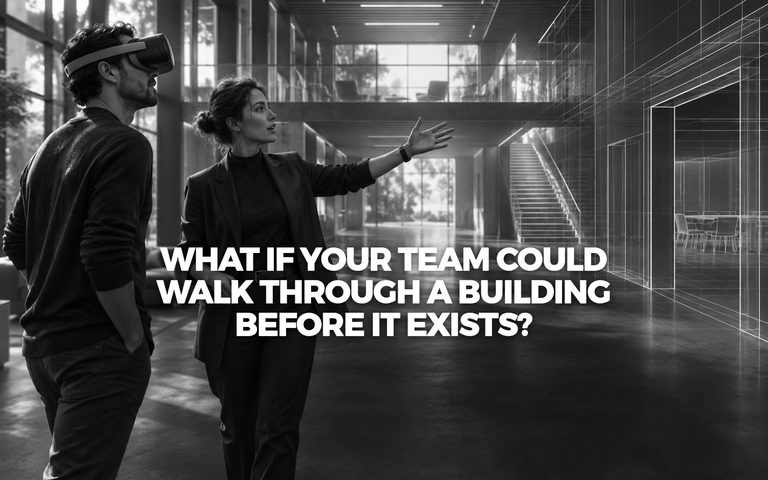
What If Your Team Could Walk Through a Building Before It Exists?
The building hasn’t been constructed yet. The machines haven’t arrived. The production line is still a collection of drawings and technical specifications.
And your team is already walking through it.
An engineer checks whether there’s enough space to access a critical component. A maintenance technician explores the equipment they’ll eventually operate. An investor steps inside the facility they’ve been asked to fund.
Someone notices that a service corridor is too narrow. Another person suggests moving a piece of equipment before installation begins.
These are conversations that traditionally happen around drawings, computer screens or, sometimes, after construction has already started.
With digital twin technology and interactive 3D environments, teams can explore certain decisions much earlier.
For businesses developing complex buildings, industrial facilities and machinery, that creates an interesting opportunity: more time to make good decisions while changes are still relatively easy to make.
What is a digital twin, and what can it actually do?
A digital twin is a digital representation of a physical asset, system or process, designed to help people understand, analyse or predict how it behaves.
Depending on its purpose, a digital twin may combine 3D geometry, engineering information, operational data and simulation capabilities.
For example, a manufacturing company might use a digital twin to monitor equipment performance, examine different production scenarios or plan maintenance activities.
The National Institute of Standards and Technology (NIST) identifies monitoring, simulation, prediction and optimisation as important applications of digital twins in manufacturing.
Source: National Institute of Standards and Technology, Digital Twins for Advanced Manufacturing.
There’s an important technical distinction, though.
A photorealistic 3D walkthrough can be extremely useful for design reviews, training and presentations, even without a live connection to a physical asset. A fully connected operational digital twin goes further, synchronising relevant information with the real-world system.
The right level of complexity depends on the job.
A property developer presenting an unbuilt building to investors has different requirements from a factory operator monitoring equipment conditions.
Both can benefit from an interactive digital environment. They simply need different capabilities.
See the building before the first brick is laid
Architectural drawings are essential. So are BIM models, engineering documentation and detailed construction plans.
But reading a drawing and experiencing a space are different things.
Consider a new logistics facility.
On paper, the layout appears sensible. Storage areas are clearly marked, equipment locations are defined and the building meets the project’s specifications.
Now imagine walking through that facility at full scale before construction begins.
A warehouse manager can assess the relationship between working areas. A technician can inspect access around machinery. An investor can understand the scale of the project without interpreting dozens of technical drawings.
The discussion becomes much more specific.
“Can we move this equipment closer to the loading area?”
“Will maintenance staff have enough room to work here?”
“Can we show the client how the finished facility will look from the entrance?”
Some of these questions can already be answered using conventional design software. Interactive environments make the information accessible to a broader group of stakeholders, including people who don’t work with engineering drawings every day.
And when more people can understand a design, they have a better opportunity to contribute before important decisions are finalised.
Better design reviews can mean fewer expensive surprises
One of the most useful applications of digital twin technology is the ability to examine design decisions before committing resources.
Moving a machine in a digital environment is relatively straightforward.
Moving it after installation may require contractors, equipment downtime and changes to surrounding infrastructure.
That doesn’t mean every design issue will be detected virtually. The accuracy of the model, the quality of its source data and the review process all matter.
But a well-prepared digital environment can help teams identify spatial conflicts, evaluate alternatives and communicate proposed changes.
Research from NIST supports the broader economic potential of digital twins in manufacturing.
In its 2024 report Economics of Digital Twins: Costs, Benefits, and Economic Decision Making, NIST estimated that widespread adoption of digital twins could generate approximately $37.9 billion in annual benefits across US manufacturing.
That figure is a modelled industry-wide estimate, rather than a guaranteed saving for individual companies. The report also emphasises that the economic value of a digital twin depends on the complexity of the system and the consequences of making suboptimal decisions.
Source: Douglas S. Thomas (2024), Economics of Digital Twins: Costs, Benefits, and Economic Decision Making, NIST Advanced Manufacturing Series 100-61.
For a business evaluating a digital twin investment, that suggests a practical starting point: identify the decisions where better information could make a meaningful financial difference.
Train employees on equipment before it arrives
A new production facility is preparing to open.
The equipment has been ordered. The operating procedures are being developed. The maintenance team will need to understand machinery that hasn’t yet been installed.
Traditionally, hands-on training depends heavily on access to the physical equipment.
That can create scheduling challenges, particularly when machines are expensive, located overseas or already needed for production.
An interactive training environment offers another option.
Employees can explore a digital representation of the equipment, locate components, study procedures and rehearse selected tasks before working on the physical machine.
For example, a maintenance technician could practise identifying the correct access panel and following a defined inspection sequence.
A new operator could become familiar with the layout of a production line before entering the facility.
Teams in different countries could also work with the same digital training environment.
Of course, virtual training doesn’t replace every physical exercise. Tasks involving tactile feedback, physical resistance or real-world safety certification may still require hands-on assessment.
But employees can arrive at the real equipment with a stronger understanding of what they’re about to do.
That’s a useful head start.
Show investors and customers something they can actually explore
Some products are difficult to demonstrate.
A property development hasn’t been built yet. An industrial machine is too large to transport to a trade show. A vessel is being manufactured on the other side of the world.
Photos, technical drawings and videos can communicate a great deal. Interactive 3D environments give potential buyers another way to understand the asset.
A developer can invite investors to explore an unbuilt property.
A machinery manufacturer can demonstrate a full-scale model of equipment without transporting it.
A shipbuilder can walk a customer through the layout of a vessel while important design choices are still being discussed.
For sales and investment presentations, this changes the conversation.
Instead of relying entirely on explanations, the customer can examine the asset, ask questions about specific features and understand how different elements relate to one another.
It can also make meetings more productive.
A customer who notices something during a walkthrough can discuss it immediately with the engineering or commercial team.
That shared visual reference is particularly valuable when stakeholders have different technical backgrounds.
From visualisation to operational intelligence
The opportunities don’t end when construction is complete.
A connected digital twin can help teams understand how a physical asset is performing and evaluate possible changes.
In manufacturing, digital twins can combine operational information with models of equipment and processes.
Depending on the implementation, teams may use them to examine machine conditions, investigate production bottlenecks, plan maintenance or compare operating scenarios.
For example, an operations manager could explore how changes to equipment settings might affect production.
A maintenance team could examine performance information associated with a specific machine.
An engineering team could test a proposed process modification in a simulation before applying it to the physical system.
The value depends on the quality of the underlying information and the reliability of the model.
NIST’s research into advanced manufacturing digital twins emphasises the importance of model validation, interoperability and effective data management.
Source: National Institute of Standards and Technology, Digital Twins for Advanced Manufacturing.
These requirements become especially important when digital twins are used to support operational or safety-critical decisions.
A visually impressive model may help people understand an asset. Reliable operational analysis requires accurate data and appropriate validation.
How Alterland Digital Twin helps businesses explore, train and plan
At Alterland, we build photorealistic digital environments for organisations working with complex physical assets.
Our Digital Twin solutions support different stages of an asset’s lifecycle, from early visualisation to training and more advanced operational applications.
For property developers and industrial manufacturers, a Showroom Twin allows customers, investors and stakeholders to explore an asset in an interactive environment.
For organisations preparing employees to work with complex machinery, a Training Twin can provide interactive equipment familiarisation and procedure rehearsal.
More advanced implementations can incorporate simulation and operational information where the project requires it.
We use technologies including Unreal Engine 5, NVIDIA Omniverse and OpenUSD to build environments that can support detailed visualisation and future development.
Access can be provided through desktop and VR experiences, depending on the solution.
The starting point is always the business use case.
A company presenting a new building to investors may need a highly detailed interactive walkthrough.
A manufacturer training maintenance technicians needs accurate equipment information and realistic procedures.
An industrial operator exploring predictive maintenance has additional requirements involving data integration and model reliability.
These projects shouldn’t all be treated as the same product with different graphics.
The best solution is the one designed around what people actually need to accomplish.
Where should a company start with digital twin technology?
You don’t need to digitise an entire factory to begin.
In fact, starting with a clearly defined use case can make it easier to evaluate whether the investment is worthwhile.
Consider a single asset, process or project where better visualisation, training or simulation could create measurable value.
A company might begin with an interactive model of one machine used in employee training.
A property developer might create a walkthrough for an upcoming investment presentation.
A manufacturer might develop a simulation to evaluate changes to a specific production process.
Before choosing the technology, establish what the project should improve.
Could it reduce the time required to prepare new operators? Help stakeholders identify design changes earlier? Make technical sales presentations more effective? Support better maintenance planning?
The answers will determine what the digital environment needs to include.
And they provide a way to assess whether the project has delivered value.
The best time to understand an asset might be before it exists
A new building will eventually be completed. The machines will arrive. Employees will begin operating the facility.
But many important decisions happen long before that moment.
Digital twin technology gives businesses more ways to explore those decisions, involve the right people and prepare for what comes next.
An engineer can inspect a design earlier. A technician can become familiar with equipment before installation. An investor can understand a project more clearly. An operations team can explore alternatives before changing a working process.
Each of those possibilities is valuable for a different reason.
And for companies developing complex physical assets, having more opportunities to understand, test and improve a project before committing resources is a compelling place to start.
Have a building, machine or industrial project you’d like to bring into an interactive digital environment? Explore Alterland Digital Twin and tell us what you’re working on.