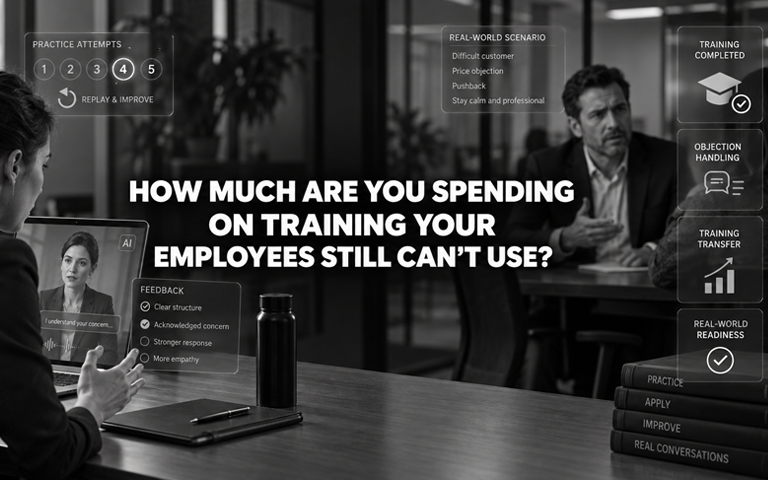
How much are you spending on training your employees still can’t use?
The training was good. People showed up, participated and gave it decent scores afterwards.
Then three weeks pass.
A customer says, “Your competitor is 20% cheaper,” and the salesperson starts discounting before they’ve even understood the objection.
A manager has to tell someone their performance isn’t good enough and spends twenty minutes circling the issue without actually saying it.
A customer service employee knows the escalation procedure. Then a genuinely angry customer calls and the procedure suddenly becomes much harder to follow.
This is one of the more expensive gaps in employee training: people can understand what they’ve been taught and still struggle to use it when another human being is involved.
Completing training tells you very little about someone’s readiness
Corporate training is full of things we can count.
Attendance. Completion rates. Test scores. Certificates. Hours spent learning.
Useful numbers, up to a point. They can tell you whether someone attended the course, finished the module or remembered enough information to pass a test.
They can’t tell you whether that person can handle an angry customer on Thursday afternoon.
This distinction matters because companies put very different things under the label of employee training.
Learning a new expense policy is mainly a knowledge problem. You need the information, you need to understand it, and you need to know where to find it later.
Giving difficult feedback is different. So is negotiation. Interviewing a candidate. Handling a sales objection. De-escalating a customer complaint.
You can explain all of those skills. You can give people frameworks and examples. You can show them what a good conversation looks like.
Eventually, though, somebody has to open their mouth and do it.
Knowing the framework helps until the other person stops following the script
Take a manager who’s been trained to give difficult feedback.
They’ve learned how to prepare. They know they should use specific examples, explain the impact of the behaviour, listen to the employee’s perspective and agree on next steps.
Fine.
Then the employee says:
“That’s completely unfair. Nobody ever told me there was a problem.”
The manager now has several jobs at once. They need to listen, decide whether the objection is valid, manage their own reaction, keep the conversation on track and choose what to say next.
The framework hasn’t become useless. It’s simply no longer enough on its own.
The same thing happens in sales training. Objection-handling techniques look perfectly sensible on a slide. They become considerably less tidy when a real customer interrupts halfway through the answer, introduces a second objection or simply says, “No, I still don’t see why you’re worth that price.”
Real conversations are inconvenient like that.
Some skills need to become available under pressure
There is a reason people practise presentations out loud instead of reading the slides repeatedly.
There is also a reason emergency procedures are rehearsed rather than merely documented.
Knowing what should happen and being able to execute it are different stages of learning.
Conversation skills have the same requirement, although workplace training often treats them as if understanding the concept should be enough.
It rarely is.
A person gets better at handling objections by handling objections. Managers become more comfortable giving difficult feedback after they’ve had difficult feedback conversations. Customer service employees learn to stay calm under pressure by experiencing pressure and working through it.
Experience eventually creates fluency.
The awkward part for employers is deciding where that experience should come from.
Because a real customer is a fairly expensive training partner.
This is why role-play has survived decades of terrible role-play
Almost everyone who has been through corporate training knows the exercise.
“Pair up. One of you is the manager. One of you is the employee.”
There is usually some nervous laughter.
The “difficult employee” makes a respectable attempt at being difficult while also being quite helpful because they know their colleague is trying to complete an exercise. Five minutes later, everyone switches roles.
It can feel artificial because it is artificial.
And yet role-play keeps appearing in sales training, leadership development and customer service programmes for a good reason: people need to practise doing the thing, not just hearing about it.
Good human role-play can be extremely valuable. An experienced trainer or actor can create a realistic situation, notice subtle behaviour and give feedback that goes well beyond a score.
The problem appears when you need enough practice for a large number of people.
One attempt in a workshop is still one attempt.
One role-play usually teaches you what you need to practise
The first attempt is often messy.
That’s useful.
Maybe the salesperson talks too much.
The manager softens the feedback until the employee has no idea there’s a performance problem.
The interviewer asks three questions at once.
The customer service employee becomes so focused on following the process that they stop listening to the customer.
Now there is something concrete to work on.
Ideally, the participant would start again.
Then again.
They could change the opening, try a different question, leave a silence alone instead of rushing to fill it, or see what happens when they stop defending the price and start investigating the objection.
By the fifth attempt, the conversation usually feels different from the first.
Getting people to attempt it five times is where training logistics become less friendly.
Repetition becomes difficult very quickly at scale
Imagine 400 employees need to practise one 30-minute conversation.
One attempt each creates 200 hours of individual role-play.
If meaningful practice requires several attempts, multiply accordingly. Then add the person playing the customer, employee or candidate, trainer availability, feedback and scheduling across different teams or countries.
Human practice hasn’t suddenly become ineffective. It has become expensive and difficult to organise in sufficient quantities.
Companies tend to solve this by reducing the number of repetitions.
Everyone attends the workshop. Everyone does one exercise. The programme is complete.
Administratively, yes.
From a skills perspective, perhaps not.
There is another reason people play safe during workplace role-play
Failing privately is uncomfortable.
Failing in front of colleagues is worse.
During group training, participants know that the people watching them today will still be their colleagues tomorrow. That changes behaviour.
People reach for responses they already know. They avoid experimenting with something that might sound clumsy. They try to look competent.
Unfortunately, practice is one of the few places where looking incompetent for a while is actually useful.
You want the salesperson to discover that their favourite answer to a pricing objection doesn’t work.
You want the new manager to hear how vague their feedback sounds.
You want someone to try the wrong approach, notice what happened and have another go.
Much better here than with the customer who is deciding whether to sign a contract.
AI role-play is useful when it buys people more attempts
This is the part of AI in employee training that interests us at Alterland.
There are already plenty of tools that can explain a negotiation technique, summarise a leadership model or generate a list of suggested responses. Access to information isn’t particularly scarce anymore.
Access to individual practice is.
An AI role-play can give each employee a conversation partner that doesn’t need to be scheduled, doesn’t mind running the same scenario again and isn’t going to meet them by the coffee machine tomorrow.
A salesperson can face a customer pushing back on price. A manager can practise with an employee who becomes defensive. Someone in customer service can work through an escalation.
Then they can restart.
The sixth attempt doesn’t consume another hour of a trainer’s day.
For a small team doing occasional development, that advantage may not matter much. For hundreds of people who need to practise the same core behaviours, it starts to matter a lot.
The technology won’t rescue a bad training scenario
A realistic AI avatar can still deliver a useless exercise.
The scenario has to reflect a situation people actually encounter.
Consider the difference between these two instructions:
“Practise handling a sales objection.”
and:
“You’re speaking to the procurement director of an existing prospect. They like the product but have received an offer from a competitor that’s 20% cheaper. Your objective isn’t to discount immediately. You need to understand what they’re comparing and whether price is actually the reason the deal is at risk.”
Now there is something to practise.
The persona matters too. So does the context, the desired behaviour and the way performance is evaluated.
If everybody receives generic scenarios and generic feedback, adding AI won’t suddenly make the training relevant.
Good simulation starts with good training design.
Sometimes a human is still the better person to practise with
A senior executive preparing for an unusually sensitive conversation may get far more value from an experienced coach.
A small management team can spend an afternoon doing intensive role-play with a skilled facilitator.
Some conversations contain so much organisational or emotional context that reducing them to a repeatable scenario would strip away the useful part.
That’s fine.
The case for AI role-play becomes stronger when a skill needs individual repetition across a larger group.
Sales teams dealing with the same recurring objections are an obvious example. So are managers learning performance conversations, customer service teams handling common escalations, recruiters practising interviews or employees preparing for a new product launch.
These are situations where an organisation can identify recurring patterns, build realistic scenarios around them and let people practise more often than a classroom schedule normally allows.
At Alterland, that’s the role we designed AI Partner to fill. Companies can build scenarios around their own personas, playbooks and situations, then let employees practise them individually on desktop or in VR.
The trainer still has a job. A rather important one, actually.
Someone needs to decide what good performance looks like, build useful scenarios, understand where people are struggling and decide what development should happen next.
Giving 400 people their fourth attempt at the same conversation doesn’t necessarily need to be that person’s job.
Training transfer deserves more attention than training completion
There is a term for what happens when people successfully use something learned in training back at work: training transfer.
It’s a more demanding way to think about employee development because it moves the finish line.
The course ending isn’t the finish line.
Neither is passing the quiz.
If the company paid for sales training because it wants salespeople to handle objections better, then the useful outcome is better objection handling.
If managers attended difficult conversation training, the outcome has to show up in difficult conversations.
That sounds obvious written down. Training systems don’t always behave as though it is.
Completion is easier to measure.
Capability is harder.
But once training involves practice, organisations can start asking better questions. Where are people consistently struggling? Do they improve between attempts? Can they handle a harder version of the same situation? Are there behaviours that an entire team hasn’t mastered yet?
Those answers tell you considerably more than a completion dashboard.
Before you buy another training course, check what’s missing
When employees know what to do and still aren’t doing it well, more information may not help.
They may need a place to try.
To get the wording wrong.
To hear an objection they weren’t expecting.
To discover that their first approach makes the situation worse.
And then to start the conversation again without losing a customer, damaging a relationship or having fifteen colleagues remember the attempt.
That’s a very different training requirement from delivering knowledge.
It also explains why a programme can receive excellent feedback, achieve a 98% completion rate and still leave people unprepared for Tuesday morning.