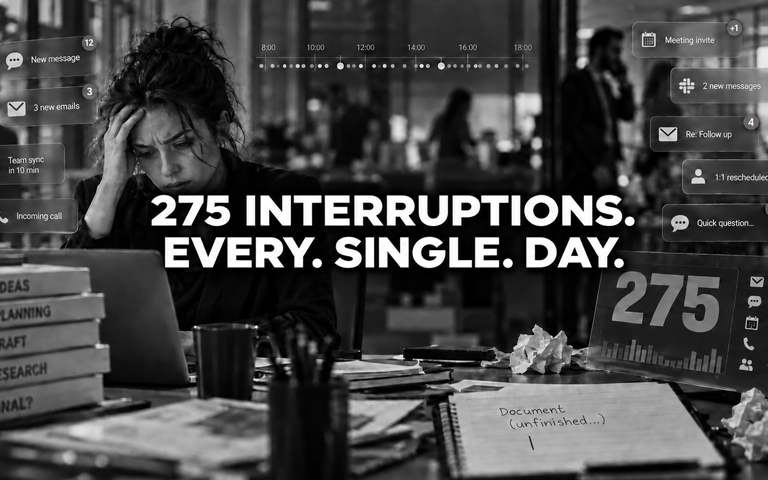
275 interruptions. Every. Single. Day.
How much uninterrupted time did you actually have at work today?
You open a document and start writing.
A Teams message arrives. You answer it, go back to the document and spend a few seconds finding the sentence you were working on.
Then an email.
Back to the document.
Calendar reminder. Meeting in ten minutes.
After the meeting, somebody messages you about something that came up during it. You answer, open the document again and realise you need to leave for another call in twenty minutes.
At 5 PM, you’ve been busy all day. The work you wanted to finish is still open.
This is becoming a fairly ordinary working day. And the data on workplace productivity suggests that the problem isn’t simply how much work we have. It’s how rarely we’re allowed to stay with one thing long enough to actually do it.
How often are employees interrupted at work?
Microsoft’s 2025 Work Trend Index offers a fairly uncomfortable answer.
Its Microsoft 365 telemetry found that during core working hours, employees in the highest 20% for notification volume received a meeting invite, email or chat roughly once every two minutes. Across a full day, that amounted to 275 interruptions.
The methodology matters here. This isn’t a claim that every employee everywhere receives exactly 275 interruptions. Microsoft calculated the figure using aggregated and anonymised Microsoft 365 productivity signals, and the 275 figure refers to the top 20% of users by ping volume.
Even with that qualification, it gives us a useful picture of what high-interruption knowledge work now looks like.
And notifications are only one part of it.
Microsoft also found that 50% of meetings take place between 9–11 AM and 1–3 PM, periods when many people experience natural productivity peaks. At 11 AM, message activity peaks too.
So the hours that could be used for concentrated work are often the hours most heavily occupied by communication.
An interruption doesn’t end when the notification disappears
A message can take ten seconds to read.
That doesn’t make it a ten-second interruption.
You also have to remember what you were doing, reconstruct the thought and decide where to continue. If the interruption requires an answer, a new task or a switch to another application, the original work moves even further into the background.
This distinction gets lost when companies think about productivity purely in terms of calendar hours.
An employee may technically have three hours available for focused work.
But if those three hours contain a meeting at 10:30, messages throughout the morning, two “quick questions” and an email that needs an immediate answer, they don’t really have a three-hour block.
They have fragments.
Microsoft found that 48% of employees and 52% of leaders say their work feels chaotic and fragmented.
That wording is useful.
Fragmentation describes the problem better than simple busyness.
You can have a busy day and still make progress on difficult work. Fragmented work is different. Attention keeps moving before any one task gets enough of it.
Meetings are taking some of our best working hours
Meetings aren’t inherently a productivity problem.
Some decisions need discussion. Some problems are solved faster when people speak directly. Workshops, difficult conversations and collaborative work can justify having several people in the same place at the same time.
The question is whether the meeting needs to exist and whether it needs to exist now.
Microsoft found that half of all meetings occur during the two windows between 9–11 AM and 1–3 PM. Its report describes these as periods when many workers naturally experience higher productivity.
There’s another number worth noticing: 57% of meetings were ad hoc calls without a calendar invitation, according to the special Work Trend Index report.
That changes the nature of a workday.
A scheduled meeting can at least be planned around. An unexpected call competes directly with whatever someone is doing at that moment.
And because communication is visible while concentration isn’t, the meeting usually wins.
Why does the workday keep getting longer?
There are only so many hours available.
If the middle of the day fills with communication, individual work has to move somewhere.
Increasingly, that somewhere is the evening.
Microsoft found that meetings starting after 8 PM increased 16% year over year. The average employee was sending or receiving more than 50 messages outside core business hours, while 29% of active workers were back in their inbox by 10 PM.
Microsoft calls this pattern the “infinite workday.”
The name sounds dramatic until you look at what the day can actually become.
Email before work.
Meetings and messages through the most productive part of the day.
Individual work squeezed into whatever gaps remain.
Another inbox check at night.
For some people, working later is a deliberate choice. Microsoft’s research notes an important difference here: remote workers may use evening hours as a quiet period for catching up, while hybrid workers are more likely to experience the same pattern as stressful.
So an email at 10 PM doesn’t automatically prove that somebody is overworked.
But when evening work becomes the only reliable place to find uninterrupted time, there is probably something worth examining in the working day that came before it.
We keep treating communication as work
Part of the problem is that communication is easy to measure.
Calendars are full.
Messages are answered.
Emails disappear from the inbox.
Meetings happen.
All of this produces visible activity.
Focused work can look remarkably uneventful by comparison.
Someone sits quietly for two hours and produces an analysis, solves an engineering problem, writes a proposal or develops an idea.
There are no green notification dots to show for it.
This can create a strange workplace incentive: responsiveness becomes easier to demonstrate than progress.
A fast answer to a message feels productive.
Accepting another meeting feels cooperative.
Being constantly available looks like engagement.
Eventually, people become very good at responding to work and increasingly struggle to find time to do it.
Remote work isn’t necessarily the problem
It’s tempting to blame digital overload on remote work.
That explanation is too simple.
Remote work can actually create excellent conditions for concentration. No commute, fewer physical interruptions and greater control over the working environment can make deep work easier.
The problem starts when organisations try to recreate physical-office availability through digital communication.
Every desk conversation becomes a chat.
Every quick update becomes a notification.
Every discussion becomes a video call.
Every question expects an immediate response because the recipient is visibly “online”.
The office hasn’t disappeared. It has been broken into hundreds of tiny digital interactions.
And those interactions can follow employees everywhere.
More communication doesn’t automatically create better collaboration
This matters especially for distributed teams.
When people aren’t physically together, the understandable response is often to communicate more.
More status meetings.
More check-ins.
More channels.
More messages designed to make sure everyone knows what’s happening.
At some point, additional communication stops solving the distance problem and starts creating an attention problem.
Good remote collaboration needs communication, but it also needs rules about which communication deserves synchronous time.
A decision that genuinely needs six perspectives may justify a meeting.
A status update probably doesn’t.
A workshop that depends on active participation needs interaction.
Information that everybody simply needs to receive can usually travel asynchronously.
A quick question may be quick for the sender and still interrupt twenty minutes of concentrated work for the recipient.
The distinction matters more than the tool.
How can companies reduce interruptions at work?
There is no single productivity hack that fixes fragmented work.
Turning off notifications helps the individual, but it doesn’t solve a culture in which immediate replies are expected.
Blocking “focus time” in a calendar helps until colleagues routinely book over it.
Cancelling meetings helps until the same discussions migrate into dozens of messages.
Reducing interruptions requires looking at how work is organised.
A useful place to start is with a few uncomfortable questions.
Which meetings actually require live discussion?
Which recurring meetings exist because they’ve always existed?
What information could be communicated asynchronously?
Does every message require an immediate response?
Are employees expected to be visibly available throughout the day?
Can teams distinguish between urgent communication and communication that can wait?
Do people have predictable blocks of time in which nobody expects them to respond?
And perhaps most importantly: does the organisation reward output, or visible activity?
Those questions aren’t particularly glamorous.
They are considerably more useful than another list of productivity apps.
Collaboration tools should reduce coordination, not create more of it
This is also one of the principles behind how we think about distributed work at Alterland.
Technology earns its place when it helps people do something better, not when it simply adds another place to check.
For some collaborative work, being together synchronously is valuable. A workshop, onboarding session or complex discussion can benefit from people sharing the same environment and actively participating.
Plenty of other work should be left alone.
A virtual office, a video call or any other collaboration platform won’t make a team more productive if the underlying habit remains the same: interrupt everyone whenever information appears.
The harder and more useful work is deciding when people genuinely need to be together and when they need uninterrupted time apart.
Before you add another productivity tool, look at the workday
We tend to approach workplace productivity as an individual problem.
Manage your time better.
Turn off your notifications.
Try another focus technique.
Block your calendar.
Those things can help. But an employee cannot personally redesign a company that schedules meetings throughout peak working hours, expects instant replies and treats availability as evidence of productivity.
The Microsoft data points to something larger than poor time management.
When work is fragmented every few minutes and the unfinished parts spill into the evening, adding another personal productivity hack won’t change much.
Look at the calendar. Look at the messages. Look at what gets treated as urgent.
Then ask a simpler question: How much uninterrupted time do people actually get to do the work you hired them to do?