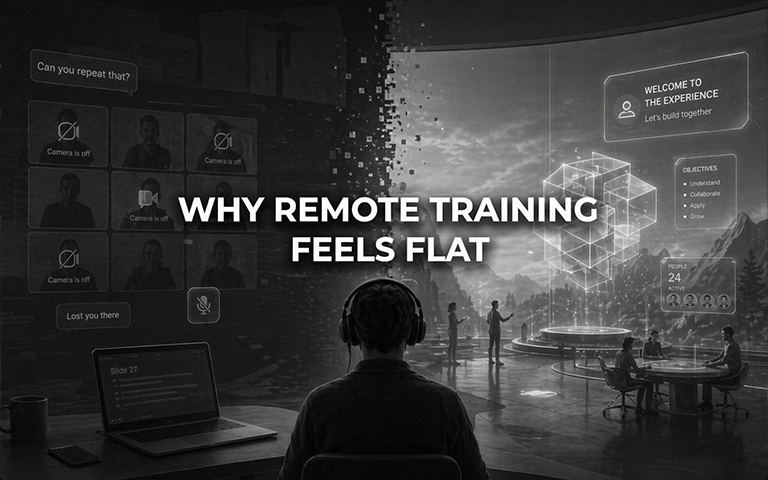
Why Remote Training Feels Flat And How Immersive Workspaces Change the Game
Remote work isn’t going anywhere.
Remote training isn’t either.
But let’s be honest - most online onboarding programs and virtual workshops feel forgettable.
Cameras off.
Multitasking on.
Energy low.
Engagement minimal.
We’ve normalized it but we shouldn’t. Because when remote training feels flat, the results are flat too. And for managers responsible for performance, culture, and speed of adaptation that’s expensive.
The Hidden Cost of Forgettable Remote OnboardingWhen onboarding happens in a traditional 2D video environment, something subtle gets lost.
New hires:
-
Consume slides.
-
Listen passively.
-
Ask fewer questions.
-
Struggle to build early connections.
Managers assume knowledge transfer happened. But knowledge absorption? Emotional connection? Cultural alignment? That’s another story.
Research in immersive learning environments consistently shows that spatial interaction increases retention and engagement. And from a practical leadership standpoint, this makes sense.
People remember experiences!
Why Most Virtual Workshops Lack EnergyTraditional remote workshops suffer from three structural problems:
-
No spatial context - everything happens in the same visual frame.
-
Limited physical interaction - collaboration is reduced to typing or speaking.
-
Low psychological presence - participants feel like observers, not contributors.
In physical spaces, energy is created through movement, shared attention, and visual anchors. Online, we flattened all of that into a rectangle. The issue isn’t remote work itself but the environment we use to deliver it.
From Passive Viewing to Active ParticipationNow imagine something different.
Instead of logging into a call, your team enters a virtual workspace that actually feels like a place.
They:
-
Walk into a dedicated onboarding room.
-
Gather around interactive 3D whiteboards.
-
Move sticky notes in real time.
-
Break into spatial discussion zones.
-
Present ideas in a shared immersive environment.
The shift is immediate. They’re not watching, they’re participating.
This is where immersive platforms, including what we’ve built at Alterland, begin to change the equation. Not by adding complexity but by restoring something essential: presence.
What Makes Immersive Remote Training More Effective?From a leadership and performance perspective, immersive training environments improve:
1. Attention
When people inhabit a space rather than stare at a grid, distraction drops. The brain registers spatial context differently than flat interfaces.
2. Memory Retention
Spatial interaction strengthens cognitive mapping. People remember where ideas were placed, how discussions evolved, and what they contributed.
3. Emotional Engagement
Personal avatars and shared digital rooms may sound like small details. They’re not.
When participants feel embodied in a space, engagement increases. Cameras-off passivity becomes much less likely.
4. Team Bonding
In immersive workshops, side conversations, spontaneous collaboration, and informal exchanges reappear - even in remote teams.
For managers, that’s culture-building at scale.
Remote Onboarding That People Actually RememberOnboarding is one of the highest-leverage moments in the employee lifecycle.
Done right, it accelerates:
-
Productivity
-
Belonging
-
Confidence
-
Alignment
Done poorly, it creates silent disengagement from day one.
In immersive onboarding environments like Alterland, new hires don’t just receive information. They explore it.
They can:
-
Navigate onboarding rooms.
-
Interact with team spaces.
-
Collaborate during learning sessions.
-
Access persistent materials in context.
-
Experience the company culture spatially, not just verbally.
The result?
Onboarding becomes an experience and people remember experiences.
Technology That Serves Leadership, Not the Other Way AroundThis is not about chasing trends. It’s not about using VR for the sake of novelty. It’s about solving a very practical managerial challenge:
How do you create energy, clarity, and connection in distributed teams?
With features like:
-
Personal avatars that humanize interaction
-
Rooms for different workflows
-
Interactive whiteboards and 3D collaboration tools
-
Unlimited virtual spaces
-
Built-in AI support for smarter meetings
Alterland was designed around one principle: Remote teams should feel like teams, not thumbnails.
The Future of Remote Work Isn’t BoringWe’ve accepted low-energy virtual experiences for too long.
Remote work doesn’t have to feel transactional. Remote learning doesn’t have to feel passive. Remote workshops don’t have to drain people.
The technology now exists to create immersive, engaging, high-performance digital environments.
The real question for leaders is: are we willing to redesign the experience of work or are we satisfied optimizing outdated formats?
If your team deserves better engagement, better onboarding, and better collaboration, it might be time to step into a workspace built for the next era of work.