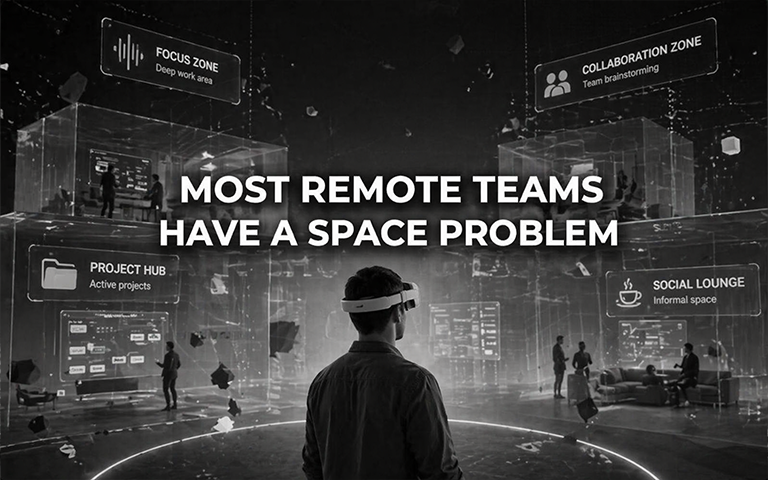
Most Remote Teams Have a Space Problem
For the last few years, we’ve been obsessing over productivity in remote and hybrid teams.
More tools.
More dashboards.
More tracking.
More meetings about meetings.
And yet - many managers still feel something is off.
In our conversations with CEOs and team leaders, we keep hearing the same sentence:
“We’re busy all day. But I’m not sure we’re building momentum.”
This isn’t a productivity issue. It’s a workspace design issue.
Remote Work Was Scaled, Not DesignedWhen the world moved remote, we simply transferred work.
The office became Zoom.
Hallway conversations became Slack threads.
Whiteboards became shared documents.
But digital replication is not digital transformation.
In physical offices, space was intentional:
-
Strategy happened in conference rooms.
-
Creative work happened around whiteboards.
-
Informal bonding happened in kitchens.
-
Focus happened at desks.
In remote work, everything happens in the same two-dimensional rectangle. That changes behavior more than we realize.
The Cognitive Cost of Flat WorkspacesHuman brains respond to space.
We think differently when we move.
We collaborate differently when we see context.
We engage differently when we feel presence.
Traditional digital tools flatten everything:
-
Every meeting looks the same.
-
Every conversation lives in the same interface.
-
Every project competes for attention in the same visual layer.
Managers feel it as fatigue.
Teams feel it as disengagement.
Leaders feel it as a lack of clarity.
This is where immersive and spatial technologies start becoming relevant, not as a trend, but as an evolution.
We’re entering a phase where workspaces are becoming:
-
3D instead of flat
-
Persistent instead of session-based
-
Designed instead of improvised
Spatial environments allow teams to:
-
Assign meaning to different areas
-
Visually map progress
-
Separate deep work from collaboration zones
-
Experience meetings as environments, not just calls
Something interesting happens when space becomes intentional again: engagement rises without forcing it.
Leadership in the Age of ImmersionModern leadership isn’t about control, it’s about architecture.
The best managers today don’t ask:
“How do I monitor my team better?”
They ask:
“How do I design an environment where my team performs naturally?”
This shift changes everything.
Instead of adding more reporting tools, forward-thinking organizations are experimenting with spatial collaboration models - environments where:
-
Brainstorming has a dedicated visual zone.
-
Project tracking is visible in real time.
-
Teams “enter” strategy sessions differently than daily standups.
Some platforms - including our work at Alterland - are exploring how immersive environments can support this kind of leadership architecture. Not as a gimmick. Not as a metaverse fantasy.
But as a practical answer to a very real managerial challenge: How do you create clarity, energy, and connection without a physical office?
This Is Not About VR HeadsetsLet’s be clear: immersive work doesn’t require everyone to sit in a headset all day.
It’s about rethinking how digital space works.
VR, AI-powered environments, and spatial platforms are simply tools enabling something deeper:
-
Intentional presence
-
Context-rich collaboration
-
Workspaces that support behavior instead of draining it
The companies that understand this early are redesigning how work feels.
The Real Question for LeadersThe future of work conversation often focuses on where people work.
Home or office?
Hybrid or remote?
A more powerful question is:
What kind of environment are we asking our people to operate in every day?
Space shapes performance more than policy ever will. The leaders who understand that will build organizations that feel cohesive - even when nobody shares the same physical address.