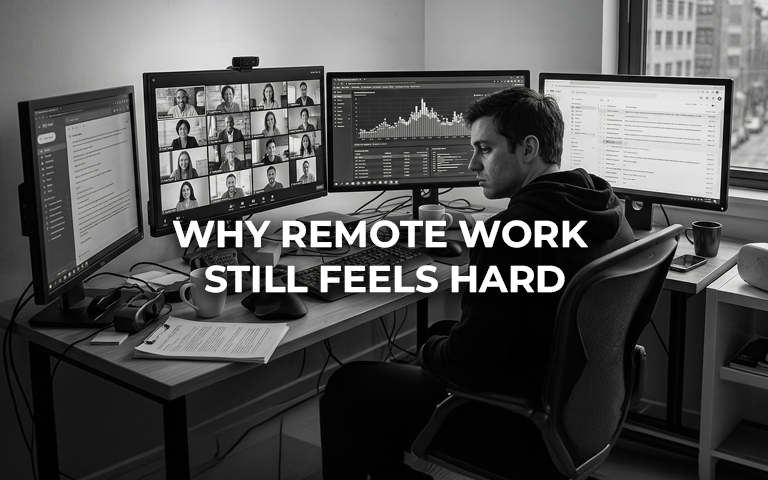
Why Remote Work Still Feels Hard (And It’s Not About Technology)
Remote work is no longer new.
Companies have invested in tools, built hybrid policies, and redesigned workflows. Employees know how to join calls, share files, and collaborate online.
Many teams still feel that remote work requires more effort than it should.
Meetings feel draining.
Communication feels fragmented.
Simple decisions take longer than expected.
The surprising truth?
The biggest challenge of remote work isn’t technology. It’s experience design.
The Early Promise of Remote WorkWhen remote work first scaled globally, expectations were clear:
-
more flexibility,
-
higher productivity,
-
better work-life balance,
-
access to global talent.
In many ways, those promises were fulfilled. Studies consistently show that employees value flexibility and autonomy more than ever before.
But something else happened along the way.
Work became digital without becoming coherent.
Instead of one office environment, teams now operate across dozens of disconnected spaces.
And the human brain struggles with fragmentation more than we realize.
The Hidden Cost of Tool OverloadMost remote teams don’t lack tools.
They have too many.
A typical workday might involve:
-
messaging platforms,
-
video meetings,
-
project boards,
-
document systems,
-
email threads,
-
shared drives,
-
internal dashboards.
Each tool solves a specific problem.
Together, they often create a new one: context switching.
Every switch forces employees to rebuild mental focus:
Where was that file?
Who made the decision?
Was this discussed in chat or during a meeting?
These micro-interruptions accumulate into cognitive fatigue - one of the main reasons remote work feels exhausting despite fewer commutes.
Work Needs Places, Not Just ToolsIn physical offices, work naturally organized itself around places.
Conference rooms meant decisions.
Desks meant focus.
Informal spaces meant brainstorming.
Digital work removed physical constraints but didn’t fully replace spatial meaning.
As a result, everything happens everywhere, and nowhere feels structured.
Humans, however, are deeply spatial thinkers. We understand collaboration better when it exists within a shared environment rather than scattered interactions.
That’s why forward-thinking organizations are beginning to rethink remote collaboration not as a collection of apps, but as an environmental experience.
The Psychology of PresenceOne overlooked element of remote work is presence.
In offices, presence was automatic. You saw colleagues thinking, reacting, collaborating. Communication included nonverbal signals that reduced misunderstandings.
Online, presence becomes abstract.
A muted microphone can mean:
-
agreement,
-
confusion,
-
multitasking,
-
hesitation,
-
disengagement.
Managers often guess - and guess wrong.
When teams feel present with one another, participation changes naturally. Conversations become more balanced, and collaboration feels less performative.
Some organizations experimenting with immersive virtual workspaces, including platforms like Alterland, have observed that shared environments can restore part of that lost presence. When people feel like they are somewhere together, interaction becomes more organic, even in fully remote teams.
Not because technology replaces human connection, but because it supports it.
Remote Work Is an Organizational Design ChallengeMany companies still treat remote work as a logistical adjustment.
In reality, it’s a leadership and design transformation.
Successful remote organizations rethink:
-
how information flows,
-
where decisions live,
-
how teams experience collaboration,
-
how visibility replaces supervision.
The question shifts from:
“How do we replicate the office online?”
to:
“How should work feel when location no longer matters?”
This mindset change is subtle but powerful.
Why Simplicity WinsThe most effective remote teams are not those with the most advanced technology.
They are the ones with the least friction.
They prioritize:
-
fewer communication layers,
-
clearer collaboration spaces,
-
visible priorities,
-
predictable workflows.
Simplicity reduces decision fatigue.
And when mental energy is preserved, creativity and problem-solving increase naturally.
The Future of Remote Work: Designed, Not ImprovisedRemote work is entering a new phase.
The first phase was emergency adoption.
The second focused on tools and policies.
The next phase will focus on experience design - creating environments where collaboration feels intuitive instead of effortful.
We are beginning to understand that productivity doesn’t come from constant connectivity.
It comes from clarity, presence, and well-designed interaction.
Organizations that recognize this early will not only improve efficiency but also attract talent seeking workplaces that feel modern, human, and sustainable.
Remote work was never meant to simply move work online. It was meant to rethink how people work together entirely.