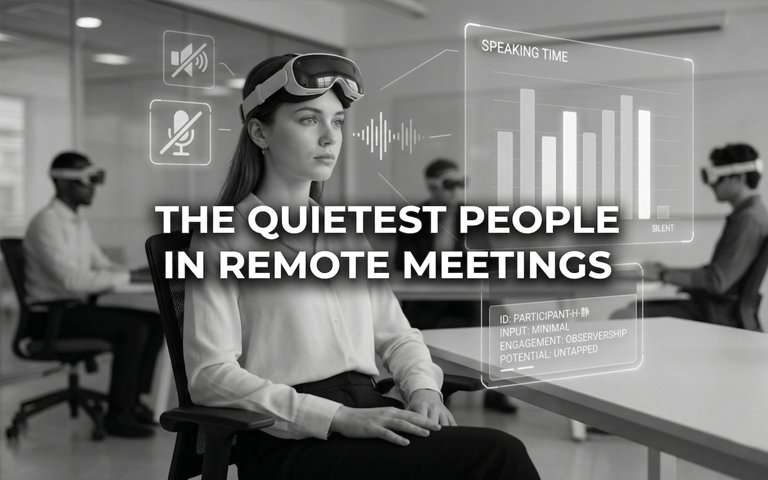
The Quietest People in Remote Meetings: The Voices Companies Are Accidentally Losing
Remote work was supposed to make collaboration easier. No commuting. Flexible schedules. Global teams working together seamlessly.
And yet, something subtle but critical started disappearing from many organizations.
Not productivity. Not efficiency. Voices.
The biggest loss in remote work isn’t what we measure on dashboards. It’s the perspectives we never hear.
Silence Looks Different OnlineIn a physical meeting room, participation happens in many ways beyond speaking.
You notice someone leaning forward.
A thoughtful pause.
Eye contact suggesting disagreement.
A quiet person preparing to add something meaningful.
Even people who rarely dominate conversations still find moments to contribute naturally.
Remote meetings changed that dynamic.
Online, silence becomes invisible.
A muted microphone looks the same whether someone is disengaged, thinking deeply, or simply waiting for the right moment to speak. Managers often interpret silence as agreement, or worse, lack of ideas.
But silence online rarely means what we think it means.
The Hidden Cost of “Efficient” MeetingsVideo calls optimized meetings for speed, not participation.
Typical remote meetings now follow a familiar pattern:
-
A few confident voices lead the conversation.
-
Others hesitate to interrupt.
-
Discussions move quickly.
-
Decisions happen before reflection catches up.
For many employees, speaking up on a crowded call feels performative, like stepping onto a stage rather than joining a discussion.
Research in organizational psychology consistently shows that psychological safety drives innovation. Yet many virtual environments unintentionally reduce it.
When conversations feel competitive instead of collaborative, quieter personalities withdraw, even when they hold the strongest insights. Companies lose ideas without ever realizing it.
Quiet Employees Are Often Deep ThinkersThe assumption that active speakers contribute the most is one of leadership’s oldest misconceptions.
Some of the most valuable contributors are people who:
-
process information internally before responding,
-
avoid interrupting others,
-
prefer structured interaction over spontaneous debate,
-
contribute best when reflection is possible.
In traditional offices, informal moments - hallway conversations, small group discussions, or post-meeting chats - gave these individuals alternative ways to participate.
Remote work removed many of those channels. What remains is often a single format: the live group call. That format favors only certain communication styles.
Why Environment Shapes ParticipationLeadership conversations often focus on communication skills:
“Encourage people to speak up.”
“Ask more questions.”
“Make meetings inclusive.”
Participation is not only a behavioral issue, it is an environmental one. People speak when interaction feels natural, not forced.
The structure of a meeting, spatially, socially, and psychologically, determines who feels comfortable contributing. When collaboration feels staged, participation narrows. When collaboration feels shared, participation expands. This is something many teams only discover after changing how they meet, not what they discuss.
What Changes When Meetings Feel Human AgainTeams working in immersive collaboration environments often notice an unexpected shift.
The same people who stayed silent on video calls begin contributing spontaneously.
Why?
Because interaction becomes closer to real presence:
-
conversations happen in smaller, more fluid groups,
-
participation doesn’t require interrupting,
-
nonverbal cues return through movement and proximity,
-
collaboration feels experiential rather than performative.
When meetings resemble shared spaces instead of broadcast sessions, communication patterns change naturally.
No training required.
Just a different environment.
Leadership Isn’t About Forcing ParticipationModern leadership advice often says: give everyone a voice but voices already exist. The real challenge is creating conditions where people want to use them.
That means shifting focus from managing speaking time to designing interaction environments that support different personalities and thinking styles.
Effective remote leaders ask different questions:
-
Does our meeting format reward only fast thinkers?
-
Are we confusing visibility with contribution?
-
Who consistently speaks last or never?
-
What ideas might appear if participation felt safer?
In remote organizations, leadership increasingly becomes an exercise in experience design.
Not control. Not monitoring. Enabling.
The Competitive Advantage of Hearing More PeopleCompanies investing in better collaboration environments often discover a surprising outcome:
Innovation increases not because teams work harder, but because more people contribute.
Diverse participation leads to:
-
better problem-solving,
-
fewer blind spots,
-
stronger engagement,
-
higher ownership of decisions.
When previously quiet employees begin sharing ideas, teams gain perspectives that were always present but never accessible.
The talent was never missing, the conditions were.
Remote Work’s Next EvolutionThe future of remote work isn’t about more meetings or fewer meetings.
It’s about better-designed interaction.
As organizations move beyond emergency remote work into intentional distributed collaboration, the question shifts from:
“How do we manage remote teams?”
to:
“How do we create spaces where every type of thinker can participate?”
Technology alone doesn’t solve this but the environments we build with it do.
Because the biggest risk for modern organizations isn’t disengaged employees.
It’s engaged employees who stay silent.
Who surprised you the most once they finally felt comfortable speaking up?