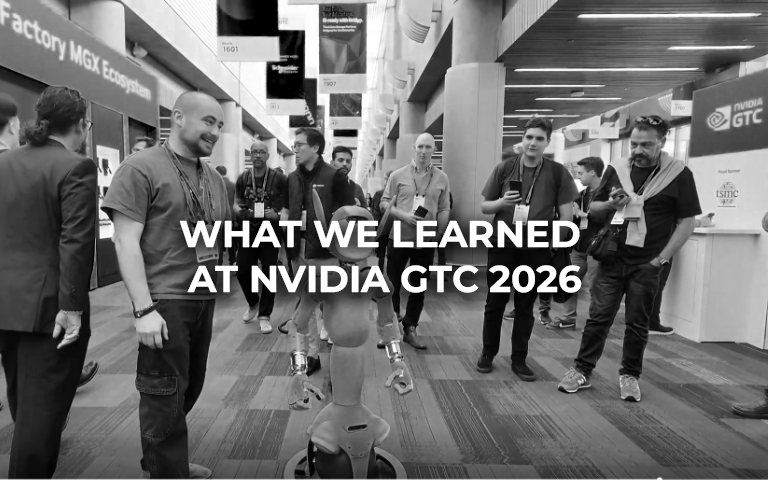
What We Learned at NVIDIA GTC 2026: AI, Spatial Computing, and the Next Era of Work
The Alterland team has just returned from NVIDIA GTC 2026 - one of the world’s most important gatherings focused on artificial intelligence, accelerated computing, and emerging technologies.
Events like GTC are often described as tech conferences. In reality, they feel more like previews of the near future.
Because what appears on stage at GTC rarely stays experimental for long. Within a few years, it becomes infrastructure.
And this year, one message was impossible to miss:
AI is no longer just a tool. It’s becoming an environment.
AI Is Moving From Assistance to PresenceIn previous years, conversations around AI focused on automation - faster analytics, smarter chatbots, better predictions.
At GTC 2026, the narrative shifted.
AI is evolving from something we use into something we work alongside.
Across keynotes and demonstrations, we saw systems capable of:
-
understanding context across multiple workflows,
-
generating real-time visual environments,
-
supporting collaboration dynamically,
-
and interacting naturally inside spatial interfaces.
This transition matters for leaders because it changes how work itself is structured.
Instead of opening tools, people increasingly enter intelligent environments.
The Convergence of AI and Spatial ComputingOne of the strongest themes at GTC was the growing connection between AI and spatial computing.
For years, immersive environments depended primarily on human input - building spaces, organizing content, managing interactions manually.
Now AI is becoming an active layer inside those environments.
Imagine collaborative spaces where:
-
meeting summaries appear automatically around you,
-
ideas organize themselves visually,
-
virtual environments adapt to the purpose of a session,
-
AI agents assist teams during workshops in real time.
This direction strongly validates what many immersive workspace platforms, including Alterland, have been exploring: digital workspaces should not just host collaboration; they should actively support it.
Simulation Is Becoming a Core Business ToolAnother major takeaway from NVIDIA GTC 2026 was the rise of simulation as a mainstream business capability.
Powered by accelerated computing and advanced AI models, companies are increasingly able to simulate:
-
training scenarios,
-
operational workflows,
-
customer environments,
-
and decision-making processes.
Simulation is moving beyond engineering and entering everyday organizational development.
For onboarding, leadership training, and remote learning, this opens entirely new possibilities. Teams can experience situations instead of only discussing them, dramatically improving understanding and retention.
This is particularly relevant for distributed organizations, where experiential learning has traditionally been difficult to replicate remotely.
Why This Matters for the Future of Remote WorkRemote work solved accessibility. But it didn’t fully solve engagement.
One recurring theme at GTC was the recognition that productivity gains now depend less on communication speed and more on quality of interaction.
AI combined with immersive environments introduces something new:
Workspaces that respond to people.
Instead of static video calls, teams interact within adaptive digital environments designed around collaboration goals.
At Alterland, this direction feels very familiar. Much of our product vision is built around the idea that remote teams need shared spaces, not just shared screens.
Seeing similar ideas emerging across the broader AI ecosystem confirms that immersive collaboration is becoming a natural evolution of digital work, not a niche experiment.
From Tools to EcosystemsPerhaps the most important insight from GTC 2026 is that innovation is no longer happening in isolated categories.
AI, VR, simulation, and cloud computing are merging into one ecosystem.
The future workplace will likely include:
-
AI agents supporting daily workflows,
-
persistent virtual environments,
-
real-time simulation capabilities,
-
and seamless transitions between physical and digital collaboration.
The question is no longer whether these technologies will converge.
It’s how quickly organizations learn to use them effectively.
Why Being at GTC Matters for AlterlandFor us, attending NVIDIA GTC isn’t about trends or visibility.
It’s about staying close to the technologies shaping how people will work, learn, and collaborate in the coming years.
Every conversation, demo, and keynote helps refine how we design Alterland’s immersive workspace — ensuring it evolves alongside the broader AI ecosystem rather than reacting to it later.
Because building the future of work requires more than vision.
It requires proximity to innovation.
The Takeaway: The Workplace Is Becoming Intelligent and SpatialIf there’s one conclusion after GTC 2026, it’s this:
The next generation of work will not happen inside isolated apps.
It will happen inside intelligent environments where AI, space, and human collaboration merge naturally.
We are moving toward workplaces that are:
-
immersive,
-
adaptive,
-
global,
-
and increasingly human-centered despite being powered by advanced technology.
And after seeing what’s coming next, one thing feels clear:
The future of work isn’t arriving suddenly.
It’s already being built, step by step, by the communities, technologies, and companies shaping conversations today.