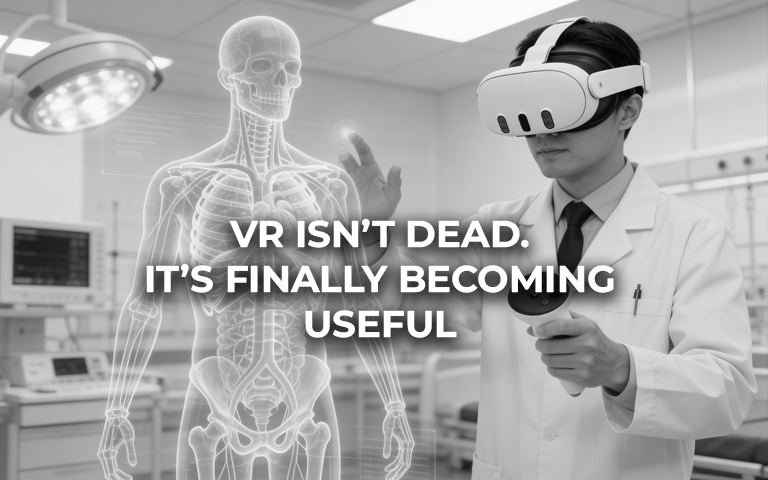
VR Isn’t Dead. It’s Finally Becoming Useful - What Meta’s New Direction Means for the Future of Work?
This week, Alterland’s founder and CEO, Dorota Sędek, landed in Shanghai.
On the surface, it’s a business trip. Meetings, conversations, new partnerships.
Every time a big tech company restructures a division, the internet rushes to declare something dead.
VR has been “dead” at least five times in the past three years - according to headlines.
And yet, here we are again.
Recent statements from Meta’s leadership, including CFO Susan Li in discussions highlighted by TechRadar, make one thing clear: VR is still very much part of the company’s long-term strategy. Development continues, new headsets are in progress, and investment hasn’t disappeared - it has simply become more pragmatic.
Which, ironically, might be the best news VR could get.
Because technology usually becomes truly valuable only after the hype fades.
The End of the VR Fantasy EraA few years ago, VR was framed as an instant replacement for everything - offices, laptops, social media, even reality itself.
That narrative created excitement, but also unrealistic expectations.
Adoption didn’t explode overnight. Companies experimented cautiously. Many leaders watched from the sidelines, unsure whether immersive technology was a revolution or just another trend cycle.
Now the conversation sounds different.
Meta openly acknowledges that consumer VR adoption is progressing more slowly than smart glasses and wearable tech. Instead of betting on one single future device, the company is balancing its investments across AI, wearables, and immersive systems.
In plain terms: VR is no longer treated as a miracle solution. It’s becoming infrastructure and that’s a much healthier place for any technology to be.
New Devices, Different PrioritiesReports suggest Meta is working on at least two upcoming devices planned for the next few years:
-
a next-generation Quest headset - an evolutionary step forward,
-
and a lighter, productivity-focused device closer to wearable glasses than traditional VR hardware.
The direction matters more than the specs.
The industry is clearly moving toward comfort, everyday usability, and work scenarios, not just entertainment.
That shift mirrors what we’re seeing in conversations with companies exploring immersive collaboration through Alterland. Leaders aren’t asking for futuristic experiences anymore. They’re asking very practical questions:
How do we make remote onboarding more engaging?
How do we run workshops people actually participate in?
How do distributed teams feel connected without forcing more meetings?
Interestingly, immersive environments often solve these problems not by adding features - but by changing how people experience digital space.
VR Is No Longer the Star of the ShowAnother subtle but important signal from Meta’s messaging is this:
VR is no longer positioned as the future.
It’s part of a broader ecosystem that includes:
-
AI-generated content,
-
smart glasses,
-
wearable computing,
-
and multi-device experiences.
Mark Zuckerberg even described a longer-term vision where AI-generated video could become entry points into immersive environments - turning passive content into interactive experiences.
This tells us something fundamental. The future isn’t VR versus AI. It’s VR with AI. For businesses, that combination is where real transformation begins.
Why Spatial Experiences Change How Teams WorkMost remote collaboration today still happens inside flat interfaces - calls, chats, shared documents.
They work. But they rarely energize people.
What immersive environments introduce is something surprisingly simple: a sense of place.
When teams enter a shared virtual space:
-
discussions feel more focused,
-
brainstorming becomes visual and interactive,
-
participation increases naturally,
-
and meetings feel shorter — even when they aren’t.
At Alterland, we’ve seen teams react the same way again and again. The technology itself stops being the focus after a few minutes. What people notice instead is that conversations feel more natural.
They stop multitasking.
They engage.
They remember sessions better.
Not because VR is magical - but because humans respond differently to environments than to interfaces.
The Quiet Shift Leaders Should NoticeThe biggest mistake leaders can make right now is waiting for a single “VR breakthrough moment.”
That moment probably won’t come.
Instead, immersive technology is improving gradually:
-
lighter devices,
-
smarter AI assistance,
-
better usability,
-
clearer business applications.
The shift will feel slow - until suddenly it feels obvious.
Just like cloud computing.
Just like smartphones.
Just like remote work itself.
Organizations experimenting today aren’t trying to be futuristic. They’re building familiarity with a new way of working before it becomes standard.
VR Is Growing Up - And That’s Good NewsThe current phase of VR may look less exciting from the outside.
Fewer bold promises.
More cautious messaging.
More practical use cases.
But this is exactly what technological maturity looks like.
VR is moving away from spectacle and toward usefulness - integrated with AI, connected across devices, and increasingly focused on productivity and collaboration.
For companies rethinking how teams learn, meet, and work remotely, this evolution matters far more than any single headset launch.
Because the real change isn’t about hardware.
It’s about redesigning digital workspaces so people feel present again, even when they’re thousands of kilometers apart.
And that’s the direction we believe immersive work is heading, not someday, but already, step by step.