Spatial Computing Is Reshaping Work But Most Leaders Haven’t Noticed Yet
For years, emerging technologies like VR, AR, and mixed reality were treated as experimental - interesting for gaming, promising for training, but not “serious business infrastructure.”
That assumption is quietly expiring.
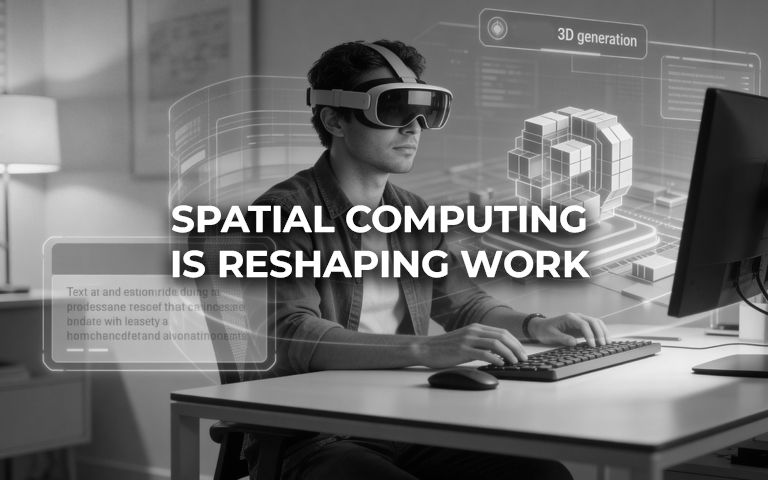
Spatial computing is no longer a futuristic concept. It’s becoming a strategic layer in how organizations design collaboration, learning, and performance.
And the leaders who understand this shift early will gain a structural advantage.
What Is Spatial Computing In Business Terms?
Forget the buzzwords for a moment.
Spatial computing simply means this: digital information is no longer limited to flat screens but it interacts with space.
Instead of:
-
Tabs
-
Windows
-
Static dashboards
We get:
-
Environments
-
Persistent rooms
-
Contextual visual layers
-
Objects you can move, cluster, and structure
It’s the difference between managing work in spreadsheets and walking into a project room where everything is visually mapped around you.
This shift changes cognition. And cognition changes performance.
Why 2D Collaboration Is Reaching Its Limits
Traditional digital work tools were built for efficiency - not immersion.
They optimize for:
-
Speed
-
Text-based communication
-
Rapid task exchange
But they struggle with:
-
Complex brainstorming
-
Emotional engagement
-
Long-form strategic thinking
-
Cross-functional alignment
In flat interfaces, every interaction competes for the same visual and cognitive channel.
Spatial systems introduce depth - literally and cognitively.
When ideas exist in space:
-
They’re easier to cluster
-
Easier to prioritize
-
Easier to remember
That’s not aesthetics, that’s neuroscience.
The VR Hardware Acceleration Effect
One major barrier to immersive work used to be hardware.
That barrier is shrinking fast.
Devices like the Meta Quest 3 and enterprise-focused mixed reality systems such as Apple Vision Pro are accelerating mainstream adoption of spatial environments.
What changed?
-
Higher resolution
-
Better hand tracking
-
Lower friction onboarding
-
More comfortable extended use
-
Stronger developer ecosystems
We are witnessing the same pattern we saw with smartphones in the late 2000s: first curiosity, then skepticism, then inevitability.
The key insight for leaders: You don’t need full company-wide headset adoption tomorrow.
But you do need awareness of where interface design is heading.
AI + Spatial = A New Productivity Layer
The real breakthrough isn’t VR alone.
It’s the combination of:
-
AI agents
-
Persistent virtual spaces
-
Real-time collaboration
Imagine meetings where:
-
Conversations are transcribed and summarized automatically.
-
Action items are spatially organized around the room.
-
Project milestones visually evolve over time.
-
AI assistants help restructure brainstorming clusters live.
This is no longer speculative. It’s becoming operational.
Some emerging workspaces - including the architecture we’re building at Alterland - are experimenting with AI-driven meeting layers inside immersive environments. The goal isn’t to impress with technology.
The goal is simple:
reduce friction and increase clarity.
From “Calls” to Designed Work Environments
In most companies, meetings are events. In spatial systems, meetings become environments. That distinction matters. An event disappears. An environment persists.
When teams return to the same digital room:
-
Their notes are still there.
-
Their visual boards are still structured.
-
Their context is intact.
This persistence dramatically reduces rework and context-switching. For distributed organizations, this becomes a competitive advantage.
The Strategic Question for Executives
Here’s the uncomfortable truth:
If your organization is still thinking of digital collaboration as “video calls + chat,” you are operating on infrastructure designed 15 years ago.
The interface layer of work is evolving.
Not loudly.
Not disruptively.
But steadily.
And the companies experimenting now will shape the standards others follow later. This is not about replacing offices. It’s not about chasing the “metaverse.”
It’s about understanding that:
The way humans interact with digital space is changing and leadership models must evolve with it.
Early Adoption Doesn’t Mean Risk - It Means Literacy
You don’t need to transform your entire company into a spatial workplace overnight.
But forward-looking leaders should:
-
Test immersive collaboration environments
-
Explore VR-enabled training
-
Evaluate persistent virtual offices
-
Understand AI integration in 3D spaces
Because five years from now, this won’t be experimental. It will be expected.
And the leaders who built literacy early will make better strategic decisions when the shift becomes unavoidable.