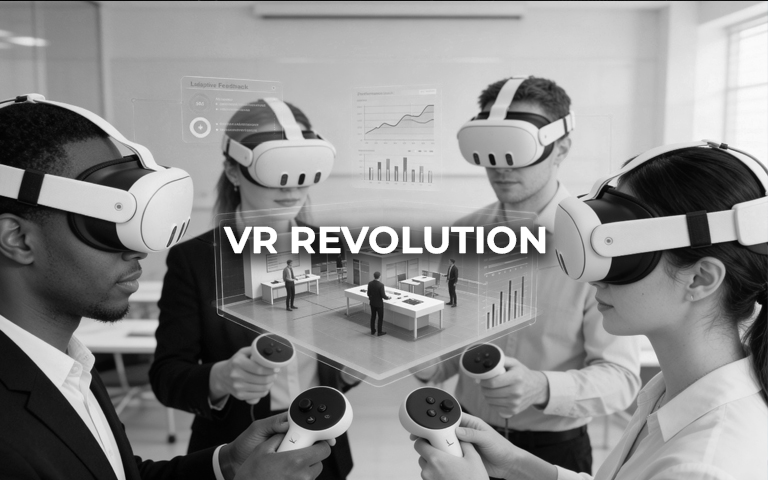
VR Revolution: From 2025 Breakthroughs to the Immersive Reality of 2026
If 2024 was the year of experimentation, 2025 was the year virtual reality became real business infrastructure.
Not a gadget or a futuristic promise but a serious layer of digital transformation.
As people who closely follow immersive technology, spatial computing, and AI-driven innovation, we can say this confidently: 2025 marked the moment when VR shifted from early adoption to strategic implementation.
And 2026 is accelerating that shift even further.
2025: The Year Virtual Reality Went Mainstream
In 2025, virtual reality crossed a psychological barrier.
For years, the conversation around VR revolved mainly around gaming and experimentation. Last year, that narrative expanded significantly. VR became a practical tool for immersive learning, enterprise collaboration, healthcare simulations, and leadership development.
Hardware Maturity and Market Growth
Major technology players strengthened their immersive ecosystems:
-
Google introduced Android XR, positioning spatial computing as a scalable ecosystem.
-
Samsung unveiled Galaxy XR.
-
Apple refined Vision Pro with performance and ergonomic upgrades.
-
Valve announced Steam Frame, reinforcing high-end VR development.
Devices such as Meta Quest 3 continued making immersive technology more accessible to both consumers and businesses.
Global adoption reached an estimated 25–30 million active users, and the market value surpassed $20 billion. But the more meaningful shift happened inside organizations.
Enterprise pilots turned into real deployments.
Virtual reality stopped being “interesting.”
It started being strategic.
The Real Breakthrough: AI + Spatial Computing
The most transformative development of 2025 wasn’t hardware alone.
It was the integration of artificial intelligence with immersive environments.
Generative AI enabled:
-
adaptive immersive learning scenarios
-
dynamic 3D environment generation
-
intelligent virtual assistants
-
personalized training paths
Spatial computing blurred the line between digital and physical space, allowing users to interact naturally with 3D content.
For leadership development and enterprise training, this is critical.
When you combine AI-powered systems with immersive learning environments, you create spaces that respond to participants in real time.
That’s not just engagement.
That’s behavioral impact.
Enterprise VR: From Experiment to Implementation
By 2025, virtual reality applications extended far beyond entertainment.
Immersive Learning and Training
Organizations began using VR training platforms to simulate real-world scenarios - from onboarding experiences to high-stakes leadership decisions.
Instead of consuming information, participants experienced it.
Instead of watching slides, they collaborated inside interactive virtual environments.
This is where immersive leadership and immersive onboarding gained momentum.
For example, platforms like Alterland are designed specifically for immersive leadership development and remote team collaboration - enabling organizations to create virtual training environments that combine spatial interaction, AI-powered tools, and real-time co-creation.
The focus is no longer on “using VR.”
It’s on designing immersive ecosystems that support measurable performance outcomes.
Healthcare and Simulation
Healthcare institutions expanded VR for surgical simulations, therapy, and pain management. The realism and emotional engagement of immersive environments improved both training precision and patient outcomes.
Remote Work and Virtual Collaboration
Hybrid work models matured significantly.
Organizations started exploring immersive collaboration environments that go beyond traditional video conferencing. Spatial presence, shared 3D workspaces, and interactive tools began redefining how distributed teams connect.
This shift is especially visible in immersive leadership platforms that support:
-
remote leadership development
-
distributed strategy sessions
-
interactive workshops
-
culture-building experiences
The goal is simple: recreate presence - without physical proximity.
2026: Intelligent Immersion Becomes the Standard
If 2025 was about validation, 2026 is about refinement and intelligence.
Three forces are shaping the next phase of virtual reality:
-
AI-native environments
-
Lighter, frictionless hardware
-
Deeper enterprise integration
AI-Generated 3D Environments
One of the most exciting developments for 2026 is the rise of AI world models.
Interactive 3D environments can increasingly be generated from:
-
text prompts
-
sketches
-
reference images
For businesses, this means:
-
faster creation of immersive training programs
-
customized onboarding environments
-
adaptive leadership simulations
-
scalable immersive learning ecosystems
Platforms operating at the intersection of VR and AI are enabling organizations to design virtual collaboration spaces that evolve dynamically based on user behavior.
This is a fundamental shift.
From static environments
to intelligent immersive systems.
Hardware Becomes More Seamless
Expect lighter, fully wireless headsets, improved battery life, finger tracking, and advanced rendering technologies.
The more invisible the hardware becomes, the more natural the immersive experience feels.
As spatial computing matures, immersive platforms will feel less like tools and more like environments.
Market Growth and Strategic Adoption
Projections suggest the VR market will exceed $26 billion in 2026, maintaining strong compound annual growth.
But what matters more than market size is integration depth.
Virtual reality is increasingly embedded in:
-
enterprise leadership development
-
immersive onboarding programs
-
simulation-based policy testing
-
remote collaboration systems
Forward-thinking organizations are no longer asking whether immersive learning is viable.
They are asking how to implement it effectively.
Why This Matters for Leaders
From a management perspective, immersive technology is not about novelty.
It is about performance.
When immersive leadership platforms are implemented strategically:
-
engagement increases
-
retention improves
-
alignment strengthens
-
training ROI becomes measurable
The convergence of artificial intelligence, spatial computing, and immersive collaboration is reshaping how we design leadership development and remote work environments.
This is not the future.
It is the present reality of high-performing organizations.
The Road Ahead
Virtual reality in 2025 proved its maturity.
In 2026, it becomes intelligent.
AI-powered immersive environments will redefine how organizations train, collaborate, and lead.
For business leaders, HR professionals, and L&D strategists, this is the moment to experiment - strategically and deliberately.
Because immersive leadership and immersive learning are no longer optional innovations.
They are becoming the new standard.
And platforms like Alterland are helping define what that standard looks like in practice.