Meta Is Closing Workrooms: What It Means for Companies Using VR at Work - and How Alterland Helps You Move Forward?
The metaverse for work is evolving.
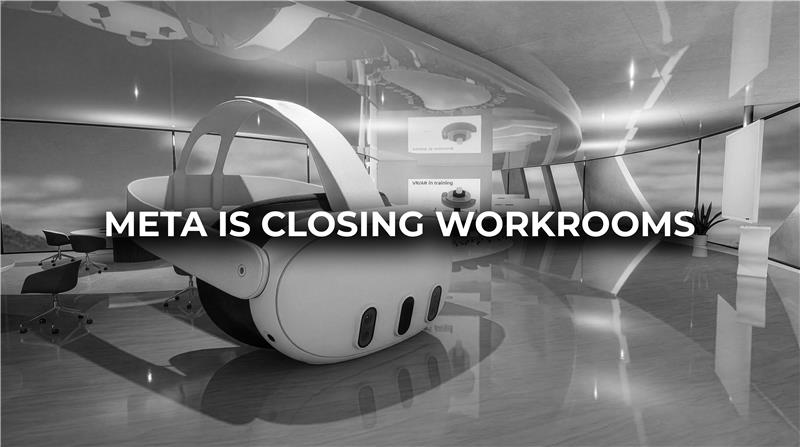
Meta has officially announced that Horizon Workrooms will be discontinued on February 16, 2026, as part of a broader strategic shift toward hardware and infrastructure. In parallel, Meta confirmed updates regarding Meta Horizon Managed Services and Meta Quest commercial SKUs, which will no longer be sold after February 20, 2026.
Existing customers can continue using Meta Horizon Managed Services – now available for free.
For organizations already using VR for collaboration, training, or meetings, this announcement naturally raises questions.
What happens next?
What about existing Meta Quest devices?
How do we protect the investment already made – both financial and organizational?
The good news: immersive work does not end here.
For many teams, this moment is actually an opportunity to move forward – with more structure, better tools, and real enterprise support.
Meta Workrooms Is Closing – But Immersive Collaboration Continues!
Many companies adopted Meta Workrooms as their first step into the metaverse for work. They tested immersive meetings, workshops, onboarding sessions, and leadership trainings. Over time, these pilots became part of everyday workflows.
When a platform like Meta Workrooms is sunset, the challenge is rarely just technical.
Organizations often experience:
- uncertainty about their VR strategy,
- internal pressure to explain previous investments,
- fear of disruption or loss of momentum,
- concern that devices will remain unused.
These reactions are completely understandable – especially in a time shaped by rapid technological change, market shifts, and broader industry restructuring.
What matters now is not why Meta made this decision – but how teams move forward from it.
Meta’s Direction Creates Space for Choice
Meta’s updated strategy clearly focuses on hardware, infrastructure, and the Meta Quest environment, while opening space for specialized platforms to deliver immersive collaboration experiences through the Meta Quest Store.
This means:
- Meta Quest devices remain relevant,
- Meta Horizon Managed Services (MDS) continue to work and are now free,
- organizations are free to choose platforms that best fit their real business needs.
In practice, this gives companies more flexibility – and more responsibility – to select solutions that go beyond experimental meetings and support real work.
Alterland: Built for Real Immersive Work, Not Experiments!
At Alterland, immersive collaboration is not a pilot project.
It is a full professional VR ecosystem designed for organizations that want clarity, control, and results.
Companies transitioning from Meta Workrooms choose Alterland because they are looking for:
- continuity instead of disruption,
- structured onboarding instead of trial-and-error,
- tools that support real facilitation, training, and decision-making.
What Companies Gain When They Move to Alterland
1. A Smooth, Guided Transition from Meta Workrooms
We understand that switching platforms can feel risky – especially when VR is already under internal scrutiny.
That’s why we:
- connecting your users,
- onboarding your team (including workshops with our VR Trainers),
- turning VR back into something your company actually uses.
Teams that have already transitioned to Alterland consistently highlight that the process was fast, calm, and predictable – without chaos or downtime.
2. Familiar Devices, No Extra Complexity
If your organization uses Meta Quest, nothing changes on the hardware side:
- Meta Quest devices remain fully supported,
- Meta Horizon Managed Services (MDS) continues to work and is now available for free,
- no need to replace or reinvest in hardware.
This is a critical point for enterprises managing larger fleets of VR devices across locations and teams.
3. Selfie-Based Avatars That Increase Engagement
One of the most frequently mentioned differences by users is our selfie-based avatars.
In Alterland:
- users can create realistic avatars based on a single selfie,
- avatars can be customized to reflect personal style and professionalism,
- privacy is respected – users can join anonymously using a random character if needed.
This is not a cosmetic feature. Being able to recognize colleagues in VR:
- increases immersion,
- boosts engagement,
- supports team culture and trust,
- makes virtual collaboration feel closer to a real office experience.
As many teams tell us: “Once you recognize people, you stop feeling like you’re in a tool – you feel like you’re together.”
4. Tools That Support Facilitators and Decision-Making
Facilitators and team leaders moving from Meta Workrooms often point out features they were missing before, such as:
- AI Agent with smart meeting notes,
- private voting and feedback boards (participants see only their own votes),
- spatial audio, allowing multiple subgroups to work in parallel,
- structured spaces designed for workshops, training, and leadership sessions.
These tools are built to support real outcomes – not just presence in VR.
From Workrooms to Real Immersive Work – With Support
Changing a collaboration platform is not just about technology.
It’s about people, habits, and confidence.
That’s why Alterland doesn’t just give you access to a platform.
We help you make immersive work actually work.
Ready for the Next Chapter of Immersive Collaboration?
If your organization is currently using Meta Workrooms – or planning what comes next – you don’t have to navigate this change alone.
👉 Book a call with our team and see how Alterland can support your next step in the metaverse for work:
https://calendly.com/customers-alterland/meeting-with-alterland